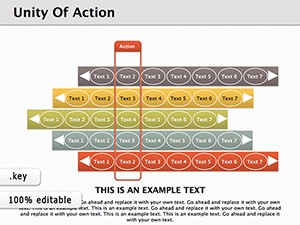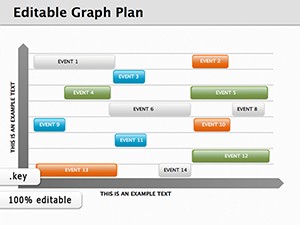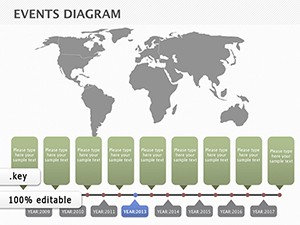
Elevate your Keynote presentations with our comprehensive collection of timeline diagram templates. Designed for professionals who need to visualize processes, illustrate project phases, or communicate complex sequences, these templates combine sophisticated design with practical functionality.
Each timeline diagram is fully editable and ready to customize for your specific needs. Whether you're preparing a product roadmap, documenting operational workflows, outlining strategic initiatives, or creating educational content, these templates provide the visual framework that keeps audiences engaged and informed. Compatible with all modern Keynote versions on Mac and iPad.
Explore our extensive library and find the perfect timeline diagram template that matches your presentation style and communication objectives.
While both timeline diagrams and timeline charts display chronological information, they serve distinct purposes and employ different visual approaches. Timeline diagrams emphasize the relationships, dependencies, and flow between events or phases. They often incorporate process elements like arrows, branches, decision points, and parallel tracks. Timeline charts focus primarily on placing events along a temporal axis with less emphasis on interconnections.
Think of timeline diagrams as the visual language for complex project ecosystems where multiple workstreams interact. A software development timeline diagram might show how design, engineering, and QA phases overlap and depend on each other. Marketing timeline diagrams illustrate how campaign elements - content creation, social promotion, email sequences - coordinate across channels. These diagrams answer not just "when" but also "how" and "what connects to what."
Professional timeline diagrams incorporate several distinctive visual components. Directional arrows show progression and flow, indicating which phases lead to others. Swimlanes organize parallel activities by department, team, or category, making it clear who owns each timeline segment. Branching paths illustrate decision points or alternative scenarios, perfect for contingency planning or showing option analysis.
Hierarchical structures appear in timeline diagrams when projects have multiple levels of detail. The main timeline might show quarterly phases, with expandable sub-timelines revealing monthly or weekly breakdowns within each phase. This layered approach lets you control information density based on audience needs - high-level for executives, detailed for implementation teams.
Icons, shapes, and color coding transform timeline diagrams from simple sequences into rich information graphics. A rocket icon might mark launch dates, gear icons indicate technical development phases, and people icons show staffing or training periods. Consistent visual vocabulary throughout your diagram helps audiences quickly parse information without reading every label.
Timeline diagrams excel in scenarios requiring process understanding. Change management initiatives use timeline diagrams to map out communication plans, training rollouts, and system transitions, showing stakeholders how different organizational changes coordinate over time. Product development cycles visualize how research, prototyping, testing, and refinement phases interact, helping teams identify bottlenecks before they occur.
Merger and acquisition integration demands sophisticated timeline diagrams showing how systems, processes, and teams converge. Legal, financial, operational, and cultural integration workstreams each follow their own timeline while maintaining critical dependencies. Timeline diagrams make these complex relationships visible to leadership teams managing the integration.
In consulting engagements, timeline diagrams establish credibility by demonstrating thorough planning. They show clients exactly how your methodology unfolds, which deliverables emerge when, and what client involvement is required at each phase. This transparency builds trust and sets clear expectations for collaboration.
Educators leverage timeline diagrams to illustrate complex historical periods where multiple events occurred simultaneously. A World War II timeline diagram might show European theater, Pacific theater, and home front developments on parallel tracks, helping students understand how these separate timelines influenced each other.
Corporate training programs use timeline diagrams to outline learning journeys. A sales enablement program might show classroom training, field observations, role-playing exercises, and certification milestones arranged to show the complete onboarding experience. New hires can visualize their development path and understand how each component builds on previous learning.
Curriculum planning benefits from timeline diagrams that show how topics interconnect throughout a semester or academic year. Teachers can display prerequisite relationships - this concept must be covered before that one - helping students see the logical progression of their learning journey.
Creating timeline diagrams that communicate clearly requires attention to several design fundamentals. Visual hierarchy ensures audiences know where to look first. Primary timeline elements should be larger and more prominent than secondary details. Use size, color, and placement to guide the eye through your diagram in the intended sequence.
Connection clarity is critical in timeline diagrams where relationships matter. Use different line styles to indicate different connection types: solid lines for direct dependencies, dashed lines for optional paths, double lines for bidirectional relationships. Color-coded connectors can show different workstreams or departments.
Label positioning prevents visual chaos. In complex diagrams with many elements, inconsistent label placement creates confusion. Establish conventions - labels always above timeline markers, descriptions always to the right - and maintain them throughout your diagram. This consistency lets audiences focus on content rather than decoding layout.
The biggest challenge in timeline diagram creation is determining appropriate detail levels. Too much information overwhelms audiences; too little leaves them with questions. Progressive disclosure offers an elegant solution: start with a high-level diagram showing major phases, then create detailed diagrams for each phase on subsequent slides.
This approach respects different stakeholder needs. Executives might only view the summary diagram, understanding the strategic timeline in one glance. Project managers dive into the detailed diagrams, using them for planning and coordination. Team members focus on the specific phase diagrams relevant to their work. One diagram set serves multiple audiences at different detail levels.
Interactive presentations in Keynote can leverage hyperlinks to create navigable timeline diagrams. Clicking a phase on the overview diagram jumps to its detailed breakdown. Back buttons return to the overview. This structure transforms linear presentations into explorable information experiences, particularly valuable in self-directed training materials or leave-behind documents.
Strategic color use dramatically improves timeline diagram comprehension. Phase-based coloring assigns each major phase a distinct hue, making it easy to track which activities belong to which phase even in complex diagrams. Status-based coloring uses colors to indicate progress: green for completed, yellow for in-progress, blue for planned, red for at-risk. This visual status reporting lets stakeholders assess project health instantly.
Team-based coloring works well in timeline diagrams showing cross-functional work. Engineering activities appear in one color, marketing in another, sales in a third. This immediately clarifies who owns what and reveals whether workload is balanced across teams or if one group is overcommitted.
Maintain sufficient contrast between elements to ensure accessibility. Timeline diagrams often appear in various contexts - projected in large conference rooms, viewed on laptops in video calls, printed in black and white for reports. Test your color choices across these scenarios to confirm readability in all situations.
Pre-designed timeline diagram templates provide professional structure, but customization makes them truly effective for your specific situation. Start by mapping your content to the template structure. If your project has four major phases but the template shows five, determine whether to combine phases or leave one blank. If you have six phases, assess whether to find a different template or reduce detail level to fit the existing structure.
Adjust visual weight to emphasize what matters most. If certain milestones are critical, make their markers larger, use bolder colors, or add subtle glow effects. If some timeline elements provide context rather than core information, reduce their visual prominence through smaller sizes or muted colors. This visual hierarchy guides attention where you want it.
Incorporate brand elements thoughtfully. Apply your company's color palette, but ensure sufficient variety to distinguish different timeline elements. Use approved fonts, but verify they remain legible at small sizes in diagram labels. Add logo placement if appropriate for external presentations, but keep it subtle to avoid distraction from diagram content.
Keynote's animation capabilities transform static timeline diagrams into dynamic presentation tools. Sequential builds reveal timeline segments one at a time, letting you control pacing and focus audience attention. Start by showing the overall timeline structure, then build in each phase as you discuss it. This prevents information overload and helps audiences process complex diagrams gradually.
Magic Move transitions create powerful before-and-after comparisons. Show your original project timeline, then transition to an updated version highlighting changes. Elements that stayed the same barely move; shifted elements glide to new positions; color changes happen smoothly. This visual diff makes schedule changes immediately apparent without requiring detailed comparison.
Emphasis animations draw attention to specific diagram elements during narration. A subtle pulse or glow on a milestone marker syncs with your verbal discussion of that phase. These subtle effects maintain audience focus during lengthy presentations without becoming distracting spectacles.
While these templates are optimized for Keynote, professional presenters often work across multiple platforms. Exporting to PowerPoint from Keynote generally preserves timeline diagram structure, though some fonts and effects may require adjustment. Test exports early to identify any compatibility issues and adjust your Keynote version accordingly if regular PowerPoint sharing is necessary.
PDF exports work well for timeline diagrams intended as reference documents rather than live presentations. All visual elements preserve accurately, and the static format ensures no one accidentally edits your carefully crafted diagram. PDFs excel for email distribution, printing, or embedding in reports.
Image exports allow timeline diagram use in other contexts - website content, blog posts, social media, or embedded in other applications. Export at high resolution to ensure clarity when resized. Consider creating both light and dark background versions for flexibility across different publishing contexts.
Dependency mapping in timeline diagrams shows which activities must complete before others can begin. Use connecting lines with arrowheads to indicate these relationships. Critical path highlighting - showing the longest sequence of dependent activities - helps project managers identify where delays have the most impact on final delivery dates.
Resource allocation overlays add another information dimension to timeline diagrams. Small bar charts beneath each phase might show staffing levels, budget allocation, or equipment requirements over time. This integrated view helps resource managers identify periods of overcommitment or underutilization.
Comparison diagrams show multiple timeline scenarios side by side. An optimistic timeline, realistic timeline, and pessimistic timeline displayed together help stakeholders understand uncertainty and make informed decisions about commitments. Version comparison diagrams track how plans evolved, showing original schedule versus current forecast.
Traditional timeline diagrams show linear progression, but agile methodologies require different visual approaches. Sprint timeline diagrams use recurring cycle symbols to show how iterations build upon each other. Each sprint might be represented as a circle or loop, with arrows showing how learnings from one cycle inform the next.
Release train diagrams coordinate multiple agile teams working on different features but converging on common release dates. These diagrams show parallel sprint tracks for each team, with vertical alignment showing which sprints contribute to each release. This view helps program managers orchestrate cross-team dependencies and timing.
Even in waterfall projects, feedback loop diagrams show how later phases can influence earlier ones. Testing might reveal design issues requiring revisiting the design phase. Timeline diagrams with backward-pointing arrows or cycle indicators acknowledge this reality and help teams plan for iterative refinement.
Start creating more effective presentations today. Download your preferred timeline diagram template and transform complex project information into clear, compelling visual stories that drive understanding and action.