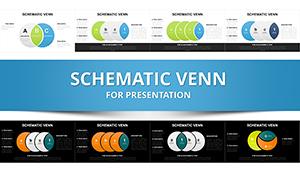
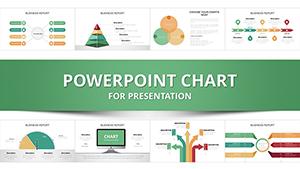
Visualize relationships, comparisons, and overlapping concepts with our extensive collection of Venn diagram templates for PowerPoint and Google Slides. These professionally designed templates help you present complex logical relationships in clear, visually appealing formats that your audience can understand instantly.
From classic 2-circle intersections to complex multi-set diagrams, our templates cover every presentation need. Business analysts use them for market analysis and competitor comparisons. Educators leverage them for teaching set theory and critical thinking. Marketing teams employ them to identify target audience overlaps and positioning strategies.
Each template is completely editable - customize colors, adjust circle sizes, modify text, and adapt layouts to match your specific requirements. Compatible with all modern PowerPoint versions and Google Slides, these designs ensure your presentations maintain professional quality across all platforms. Start creating compelling visual comparisons today with templates designed for immediate use.
Venn diagrams represent one of the most effective tools for visualizing logical relationships between different sets of data or concepts. These overlapping circle designs, named after mathematician John Venn, transform abstract comparisons into concrete visual representations. The intersection areas reveal commonalities, while non-overlapping sections highlight unique characteristics - a simple yet powerful concept that works across virtually every industry and application.
Modern presenters rely on Venn diagram templates because they communicate complex relationships at a glance. When stakeholders need to understand market positioning, product features, customer segments, or strategic alignments, Venn diagrams provide instant clarity. The visual nature of these diagrams transcends language barriers and educational backgrounds, making them universally accessible communication tools.
Market Analysis & Competitive Intelligence: Business strategists use Venn diagram templates to map competitive landscapes. Display how different companies' product offerings overlap, identify white space opportunities in the market, or illustrate your unique value proposition against competitors. Three-circle Venn diagrams excel at showing three-way market comparisons, revealing which features are industry-standard, which are competitive differentiators, and which represent your exclusive advantages.
Customer Segmentation & Targeting: Marketing professionals leverage Venn diagrams to visualize audience overlaps and identify high-value segments. Show how different demographic groups intersect with behavioral patterns and purchase preferences. The overlapping sections reveal your prime target audience - customers who satisfy multiple desirable criteria simultaneously. This visual approach makes segmentation strategies immediately clear to stakeholders.
Product Development & Feature Comparison: Product managers use Venn templates to compare feature sets across product lines or analyze customer requirements against technical capabilities. Display which features are must-haves (appearing in all circles), which are nice-to-haves (in some circles), and which are non-essential (outside all circles). This framework guides prioritization decisions and resource allocation.
Decision-Making Frameworks: When evaluating options that must satisfy multiple criteria, Venn diagrams provide visual decision support. Illustrate which solutions meet cost requirements, which satisfy technical specifications, and which align with strategic goals. Options appearing in the central intersection represent your best choices - those satisfying all critical criteria.
Educational & Training Content: Teachers and trainers employ Venn diagrams to explain set theory, logic, probability, and categorical relationships. The visual format helps students grasp abstract mathematical concepts through concrete examples. Venn templates work equally well for language arts (comparing literary themes), science (classifying organisms), and social studies (analyzing cultural similarities).
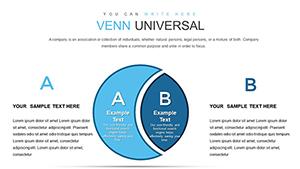
Our template collection includes multiple Venn diagram configurations, each suited to specific presentation needs. Two-circle Venn diagrams serve simple comparisons - old vs. new, our product vs. competitor's product, theory vs. practice. They're perfect for binary comparisons where you need to show similarities in the overlap and differences in the outer sections.
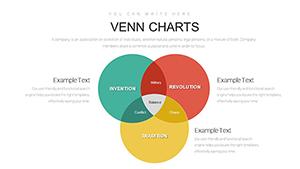
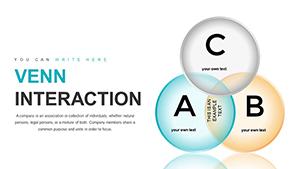
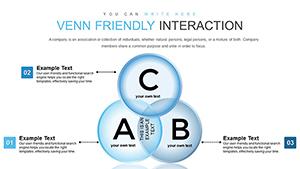
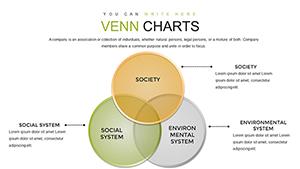
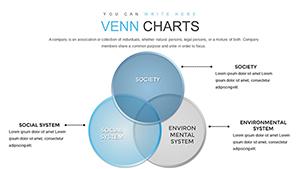
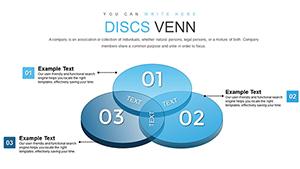
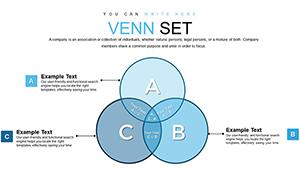
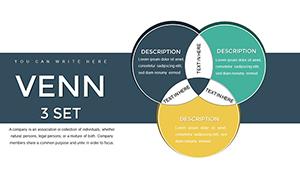
Three-circle Venn diagrams handle more complex scenarios involving three variables. They're ideal for triple comparisons like price-quality-convenience trade-offs, or for showing how three market segments overlap. The central intersection where all three circles meet represents items or characteristics common to all three sets - often your most valuable insight.
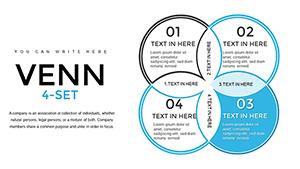
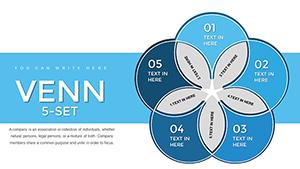
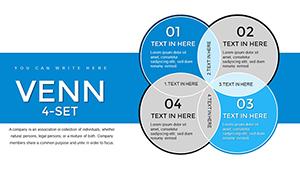
Four-circle and multi-circle designs address sophisticated analytical needs. While visually more complex, they enable comprehensive comparisons across multiple dimensions. Use these for detailed competitive analysis, complex classification systems, or when presenting research involving multiple variables. Keep labels clear and use distinct colors to maintain readability.
Specialized formats include concentric Venn diagrams (showing nested relationships), gradient-filled designs (indicating intensity or priority), and asymmetric arrangements (where circle sizes reflect relative importance or market share). Choose formats that align with your data structure and message hierarchy.
Successful Venn diagram presentations follow specific design principles. Start with clear labeling - every circle needs an immediately understandable heading. Use concise phrases rather than lengthy descriptions. Position labels outside circles for clean aesthetics, or place them along circle edges when space is limited.
Color selection significantly impacts comprehension. Choose colors with sufficient contrast to distinguish overlapping areas clearly. Semi-transparent fills work best - they allow viewers to see multiple layers simultaneously while maintaining distinct boundaries. Avoid using more than five colors in a single diagram to prevent visual confusion.
Manage text density carefully. List only the most relevant items in each section - three to five items maximum per area. If you have extensive data, create multiple slides showing different aspect comparisons rather than cramming everything into one overcrowded diagram. Bullet points or short phrases work better than complete sentences.
For data-heavy presentations, consider using quantitative Venn diagrams where circle sizes represent relative magnitudes (market share, budget allocation, population size). This adds another dimension of information while maintaining the relationship-focused nature of the Venn format.
While Venn diagrams excel at showing relationships and overlaps, other visualization tools serve different purposes. Comparison tables work better when you need to compare many specific attributes across categories - they handle more detailed information but lack the immediate visual impact of Venn diagrams.
Euler diagrams (close cousins to Venn diagrams) show only actual relationships without forcing all possible intersections. Use Euler diagrams when some category combinations don't exist in your data. Venn diagrams show all possible intersections, making them better for theoretical or comprehensive comparisons.
Matrix charts suit two-dimensional comparisons where items fall into discrete categories rather than overlapping sets. Choose matrices for positioning exercises or when you need to plot items along two continuous scales. Venn diagrams remain superior for showing shared attributes and commonalities.
For simple A vs. B comparisons, two-column layouts sometimes communicate more efficiently. However, when the similarities between A and B matter as much as the differences, Venn diagrams provide superior visualization by giving equal visual weight to the overlap zone.
Transform standard Venn templates into compelling custom designs using these advanced techniques. Apply brand colors systematically - use your primary brand color for the most important circle, secondary colors for supporting circles, and a complementary shade for intersection areas. This maintains brand consistency while ensuring visual hierarchy.
Incorporate icons or symbols within circles to reinforce categories visually. Small, relevant icons adjacent to text labels aid quick recognition and memorability. PowerPoint's extensive icon library provides thousands of options, from industry-specific symbols to abstract representations.
Experiment with circle arrangements. While traditional Venn diagrams use horizontal layouts, vertical, diagonal, or triangular arrangements can create more dynamic compositions. Arrange circles to guide visual flow in your preferred reading direction - typically left-to-right or top-to-bottom for Western audiences.
For presentations requiring multiple Venn comparisons, maintain consistent positioning and color coding across slides. If "Product A" appears in the left circle on one slide, keep it left-positioned throughout your presentation. This consistency reduces cognitive load and helps audiences follow your narrative.
Even experienced presenters make mistakes with Venn diagrams. Overcomplicated designs rank as the most common error - adding too many circles, cramming excessive text, or using confusing color schemes. Remember that simplicity drives comprehension. If your diagram requires extensive explanation, it's probably too complex.
Proportionally incorrect circles create another frequent problem. When circle size doesn't reflect the relative magnitude of what they represent (like market share or population), audiences may draw incorrect conclusions. Either ensure all circles are equal-sized when representing equal categories, or deliberately size them proportionally when magnitude matters.
Neglecting the intersection zones wastes Venn diagrams' primary advantage. The overlaps contain your most valuable insights - the commonalities that reveal opportunities, risks, or strategic alignments. Make intersection content prominent through bolding, highlighting, or color emphasis.
Finally, avoid using Venn diagrams when relationships aren't truly overlapping sets. If you're comparing sequential steps, hierarchical levels, or causal relationships, other diagram types (flowcharts, tree diagrams, or fishbone diagrams) communicate more effectively. Reserve Venn diagrams for situations involving shared attributes or categorical overlaps.