 Click to zoom
Vegetables Keynote Template Agriculture - Instant Download
| Format | .pptx |
| Slides | 3 unique layouts |
| Aspect ratio | 16:9 |
| Compatibility | PowerPoint |
| Animated | No |
| Language | English |
| License | Commercial |
| File size | — |
| Version | v1.0 |
| Last updated | March 2026 |
What's inside
What's Inside the Download
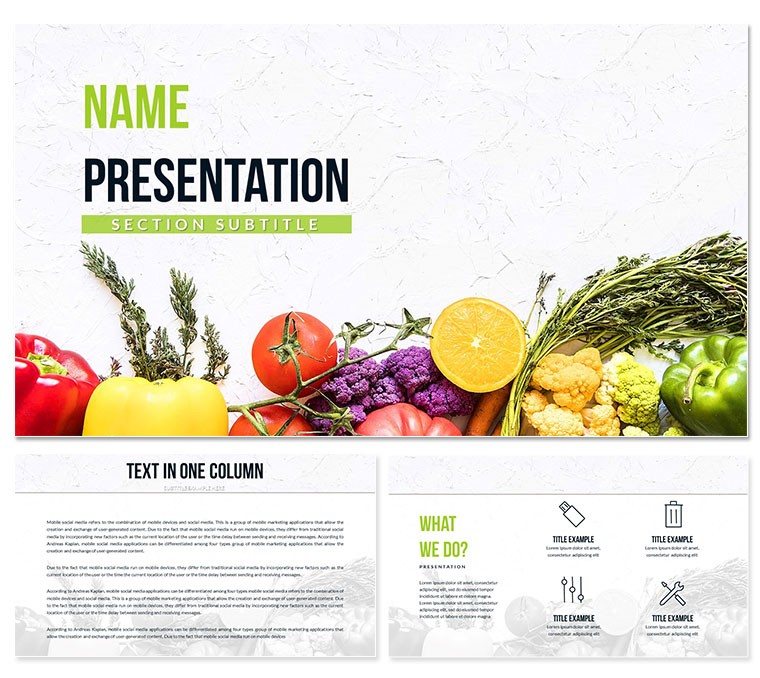
What is a vegetables Keynote template? A vegetables Keynote template is a pre-designed .key file built around the visual language of agriculture and fresh food - earthy greens, natural textures, and layout structures suited to crop data, supply chain reporting, and food industry presentations - so an agronomist, food brand manager, or farming cooperative can build a structured deck without sourcing thematic graphics from scratch.
28 diagrams and 7 color palette schemes come in the paid version, alongside 3 master slide layouts and 3 background options, delivered as both a .key file and a .kth Keynote theme. The diagram set covers the data presentation needs most common in agricultural and food business contexts: supply chain flow diagrams tracing product from field to shelf, growth timeline slides, market comparison tables, SWOT analysis matrices suited to crop variety or seasonal planning, and icon-backed list layouts for nutrient profiles or farming practice summaries. The 7 color schemes range from vibrant leaf greens and earthy ochres to cleaner neutral options for more formal stakeholder reporting contexts.
Unlike food presentation sets built around a single product category - one fruit or one meal type - this file addresses the full range of vegetable and produce industry communication tasks. A farm cooperative presenting yield data to investors, a nutritionist presenting dietary guidance to a clinic audience, and a food distributor briefing wholesale buyers on seasonal supply all face different content structures. The 28 diagram types here cover all three scenarios within a single file, with color scheme switching handling the tonal shift between a fieldwork-facing informal briefing and a formal investor presentation. The free version covers three masters and three backgrounds; the paid tier ($27) adds the complete diagram and color scheme set.
Typical Use Cases by Role
An agronomist at a regional agricultural extension service needed to present a seasonal crop performance report to a mixed audience of local farmers and government funding representatives. The supply chain flow diagrams provided a clear from-seed-to-market visual that the farming audience could follow without a data background, while the comparison table layouts handled the yield-versus-forecast numbers for the funding representatives. Preparing both slide types from the same file - rather than switching between different layout sources - cut the deck preparation time by approximately 90 minutes compared to a previous report built from a generic blank template.
A food industry consultant preparing a market entry brief for a vegetable processing client used the SWOT matrix slides and market trend timeline diagrams to structure a competitor landscape analysis. The earthy green color scheme reinforced the agricultural category positioning throughout the deck without requiring any additional graphic sourcing. The same file was reused across two subsequent client engagements in the food sector by switching to the neutral color variant for a more corporate tone.
A nutrition educator building a workshop presentation on plant-based diets used the icon-backed list layouts to illustrate nutrient content per vegetable category and the comparison table slides to show protein and fiber values side by side. The consistent visual spacing across all 28 layouts meant slides assembled in any sequence maintained a coherent visual rhythm - a practical advantage in workshop contexts where content order is adjusted based on audience questions.
Download the file and start building your agriculture or food industry presentation now.
Edit, Brand, Present: The Workflow
How do I adapt the Vegetables Keynote template to my organization's branding and data? Open the .key file, update the master palette to your brand or organization colors, replace text and diagram labels with your data, and export for presenting or distribution.
- Step 1 - Open the .key file in Keynote 12 or later (1 minute): Double-click the downloaded file. Confirm any font substitution prompts before editing begins.
- Step 2 - Select a color scheme variant (2 minutes): Review the 7 diagram color groups within the file. Choose the variant that matches the formality level of the presentation - earthy greens for field-facing and educational contexts, neutral tones for investor or stakeholder briefings.
- Step 3 - Update master slide colors to brand values (2-3 minutes): View > Master Slides > select master > Format > Fill. Input your organization's hex or RGB values. Changes propagate globally across all slides using that master.
- Step 4 - Replace text and diagram labels with your data (5-10 minutes): Click any text placeholder and type. For chart or timeline diagrams, update the label text connected to each shape or segment. All labels edit independently without unlocking grouped elements.
- Step 5 - Export (1 minute): File > Export To > PDF for printed handouts or email distribution. Use File > Export To > PowerPoint if presenting on a Windows device or sharing with partners using PowerPoint.
Editing difficulty: Beginner to Moderate. The supply chain flow diagrams take slightly longer to update than simple list slides - allow extra time for the connector-heavy layouts if data detail is high.
The Cost of Not Using a Template
Building an agriculture or food sector presentation from scratch in Keynote means sourcing earthy or green-toned thematic graphics that match each other, constructing flow diagrams with connectors that hold position when text length changes, and ensuring that color choices maintain contrast when projected in environments with variable lighting - field buildings, conference rooms, and agricultural extension offices all have different projection conditions. A non-designer assembling 15 structured slides from blank Keynote layouts typically spends 4-6 hours on the design layer before touching the actual content.
Starting from a pre-built file collapses that process to the data-replacement phase. Most users working with this file reach a presentation-ready deck in under an hour, with the bulk of time spent on the accuracy of content rather than the mechanics of slide construction.
One structural observation specific to agricultural data presentations: supply chain and process flow diagrams often need to accommodate variable text length - a distribution step with a short label sits next to a processing step with a much longer one. Flow diagrams where text lives inside connector shapes break visually when one label is significantly longer than its neighbors. The flow layouts in this file place text labels adjacent to connectors rather than inside them, maintaining diagram proportions regardless of label length - a small structural decision with a visible impact on slides carrying detailed operational data.
Download now and present your agricultural data with a structured, field-tested layout.
Frequently Asked Questions
Which Keynote version is required to open this file?Keynote 12 or later is required, available on macOS Monterey (12.0) and above. The .kth theme file can be imported in slightly older Keynote versions for basic theme use, but master slide palette editing - the primary method for applying brand or organizational colors globally - requires Keynote 12+. Keynote for iPad opens the file for presenting and basic text editing; full layout editing is recommended on macOS.
What is the difference between the free and paid versions?The free version includes 3 master slide layouts and 3 backgrounds - the visual and structural shell. The paid version ($27) adds 28 diagrams covering supply chain flows, growth timelines, comparison tables, SWOT matrices, and icon-backed lists, plus 7 complete color scheme variants. The free tier suits a basic text-and-image presentation; the paid tier enables a fully structured data and process presentation with multiple slide types suited to agricultural and food industry content.
Can I use this template for presentations to investors or government funding bodies?Yes. The 7 color scheme variants include neutral earth tone options specifically suited to more formal stakeholder and investor contexts, alongside the vibrant green variants for field-facing and educational use. Switch to a neutral palette via the slide master color controls, populate the comparison and SWOT matrix diagrams with your financial or operational data, and the file functions as a professional-grade stakeholder presentation without requiring additional design work.
How do I update the diagrams with my own data and labels?Click any text label within a diagram to select and edit it directly - labels are not locked or nested inside inaccessible groups. For flow diagrams, each connector and node label updates independently. For comparison tables and list slides, clicking a cell or list item opens the text edit mode immediately. If a label requires more text than the placeholder currently shows, resize the associated shape by dragging its boundary handles - connected elements adjust position automatically in most diagram types.
Is this template licensed for NGO, cooperative, and government use?The standard license covers presentations used in non-commercial and commercial contexts including NGO reporting, cooperative member briefings, government grant presentations, and educational workshops. The restriction applies to redistribution of the template files themselves - the .key or .kth source files cannot be shared publicly, distributed to members as a download, or bundled into a document package without a separate agreement with ImagineLayout. For organizations needing a site or multi-user license, contact ImagineLayout support directly.
What is the refund policy?ImagineLayout handles refund requests on a case-by-case basis for digital downloads. If the file does not open, the delivered content does not match the product description, or a technical fault prevents use, contact support with your order number and a description of the problem. Verifying Keynote version (12+) and macOS version (Monterey 12.0+) compatibility before purchase avoids the most common reasons a downloaded file may not function as expected.
Good for
- Project roadmaps and sprint plans
- Product launch timelines
- Quarterly or annual review decks
- Company history and milestone summaries
Licence
reviews
This helped me finish a presentation during lunch break.
The slide order already made sense so I didn’t think much.
Some colors were too bright for my taste.
The charts looked clean after adding real data.
FAQ
Will it work in Google Slides?
Are fonts embedded?
Can I use this for client work?
What's the refund policy?
Do you update the template after purchase?
Similar templates
See all Keynote templates →


All 1 slides