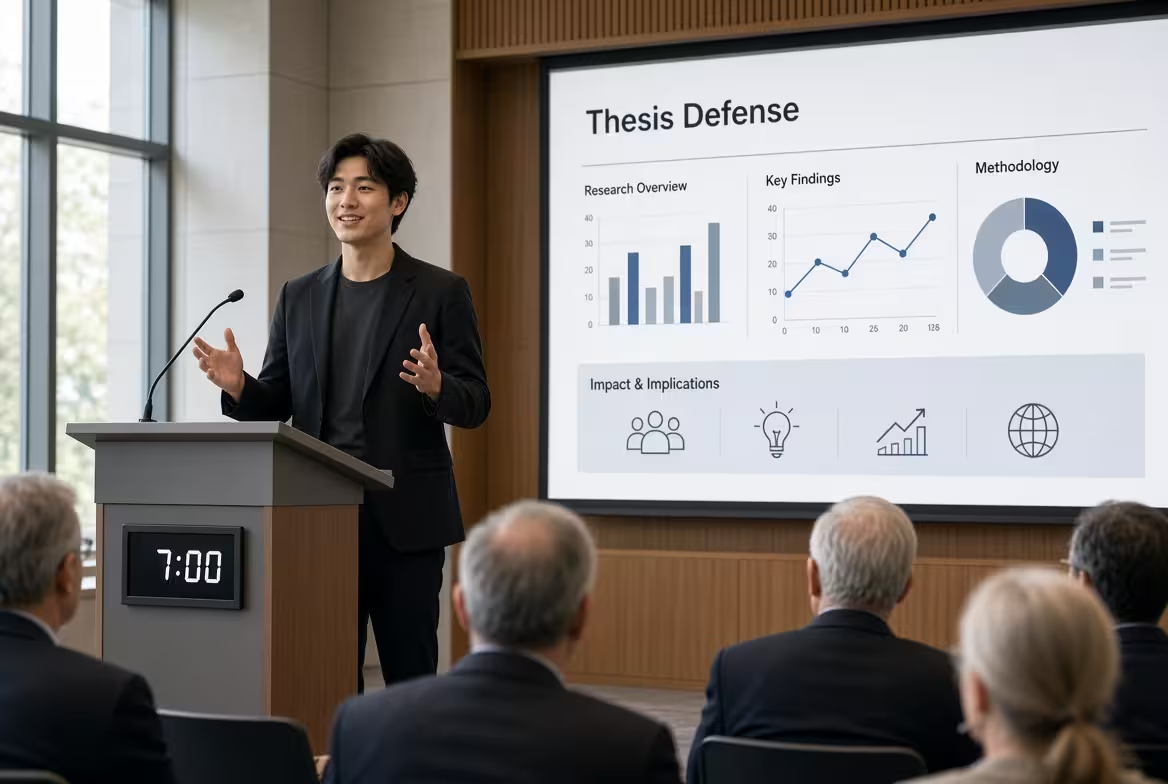
Seven minutes sounds like plenty of time until you're standing in front of a committee watching the clock hit 4:30 with your methodology slide still open. Most students prepare for this the same way they'd prepare for a five-minute investor pitch — cut everything down, keep it punchy, rehearse the opening line. That approach solves the wrong problem. A thesis or coursework defense isn't a room you're trying to move quickly through; it's a room whose entire job is to slow down and check your reasoning. Treating those two audiences the same is where most of the nerves actually come from.
This is written for students defending a course paper, thesis chapter, or short research project in a fixed 7-minute slot in front of an academic panel. If that's you, what follows is a way to decide what survives the cut, how to time it without guessing, and where confidence actually needs to show up — which usually isn't the part people spend the most time rehearsing.
The committee isn't deciding quickly — it's checking your work
A pitch audience and a defense committee look similar on paper: a small group, a short window, slides on a screen. The job each of them is doing is not the same. An investor in a five-minute pitch is deciding whether to take a second meeting — speed and clarity win. A committee in a 7-minute defense is deciding whether your method and conclusions actually hold up, and they've usually already read the paper. Their attention isn't on being persuaded fast; it's on finding the one weak joint in your argument, because that's literally their function in the room.
That distinction matters more than it looks like it should, because whether a stripped-down, minimal deck helps or hurts depends entirely on whether the audience's job is to decide quickly or verify carefully. Cut a defense deck down to five gorgeous, text-light slides the way a pitch coach would tell you to, and you've often deleted the exact evidence — a labeled chart, a sample size, a comparison table — the panel needed to see in order to trust the claim you're making. Minimal isn't automatically safer here. It can just mean under-supported.
What this changes in practice
The practical shift is small but specific: every slide earns its place by asking "would a committee member need to check this," not "does this look clean." A results table with real numbers on it isn't clutter in a defense — it's the one slide that lets the panel do their actual job without having to interrupt and ask you to repeat a figure from memory.
Build the time budget before you touch a slide template
The generic advice — "keep it short" — isn't wrong, it's just too vague to act on with a hard 7-minute limit. What actually works is deciding, in minutes, where the time goes before opening any design tool. A widely cited rule for research presentations, from Kristen Naegle's guide on effective presentation slides published in PLOS Computational Biology, is to budget roughly one minute per slide as a planning ceiling — which for a 7-minute defense caps you at somewhere around five to seven slides, not the ten or twelve a student instinctively reaches for when trying to "cover everything."
A workable split for a 7-minute academic defense looks like this:
- 0:00–0:30 — the claim, stated once, from memory, not read off slide one
- 0:30–2:00 — the problem and why it's worth the panel's time
- 2:00–4:30 — method, the section most likely to get questioned, so it gets the most time
- 4:30–6:00 — results, anchored to one slide with real numbers on it
- 6:00–7:00 — the implication of the result, then a deliberate stop
Notice the method gets nearly a third of the total time — more than the results do. That's the opposite of how most students instinctively allocate it, because method feels like the "boring" section to compress. It's also the section a defense committee is most likely to interrupt, which is exactly why it needs the room to be explained once, clearly, instead of rushed past and reconstructed badly under a question two minutes later. The discipline a short slide count forces isn't really about the number seven itself — it's that there's no room left for a slide that only exists because cutting it felt uncomfortable.
What confidence actually looks like to an evaluative panel
Generic public-speaking advice — breathe, smile, imagine the audience in their underwear — is aimed at a different fear than the one a defense actually produces. Pitch-room nerves come from social exposure. Defense-room nerves come from the very real possibility that someone is about to find a hole in your reasoning and ask you to defend it out loud, unscripted. Breathing exercises don't touch that. Preparation for the specific moment of being interrupted does.
The single highest-leverage rehearsal habit for this format: practice being stopped mid-sentence. Have someone interrupt you at an unpredictable point during a run-through and ask a plausible clarifying question — a hypothetical example would be something like "why that sample size and not a larger one" — and practice answering it in under twenty seconds before picking your talk back up exactly where you left off. Committees interrupt far more often than pitch audiences do; a student who has only ever rehearsed the uninterrupted version tends to visibly lose their place the first time it happens for real, which reads as unpreparedness even when the underlying work is solid.
One thing worth dropping entirely: apologizing for nervousness or for the format ("sorry, I'll try to keep this brief"). It doesn't buy sympathy from an evaluative panel the way it might from a casual audience — it just spends part of your seven minutes announcing a weakness nobody had noticed yet.
Where a polished deck quietly works against you
It's tempting to put disproportionate prep time into making the slides look finished, on the theory that clean design signals competence before you've said a word. There's some truth to that first impression — and also a real trap in it. A polished-looking deck tends to get less scrutiny in the room precisely because it reads as already checked — which is a real advantage right up until a committee member asks the one question your polish was quietly covering for, and there's no design choice left that can answer it out loud.
A useful test before your final rehearsal: strip the formatting mentally and just read your five to seven slides' worth of claims in order, out loud, without the spoken narration you'd normally add. If a stranger couldn't follow why slide three's conclusion follows from slide two's evidence, that's the actual problem to fix — and no amount of extra polish on the template is going to fix it for you in the room.
The seven minutes were never the hard part
Once the time budget is set and the method slide has the room it needs, seven minutes stops feeling like a countdown and starts feeling like a container — tight, but not hostile. The version of this that goes badly isn't usually the student who ran out of time. It's the student who spent their prep hours trimming slides for length instead of deciding, in advance, exactly which twenty seconds they'd need if the panel stopped them on the one point they were least sure about. That's the part worth rehearsing next, before the clock, not after it.
Comments (0)