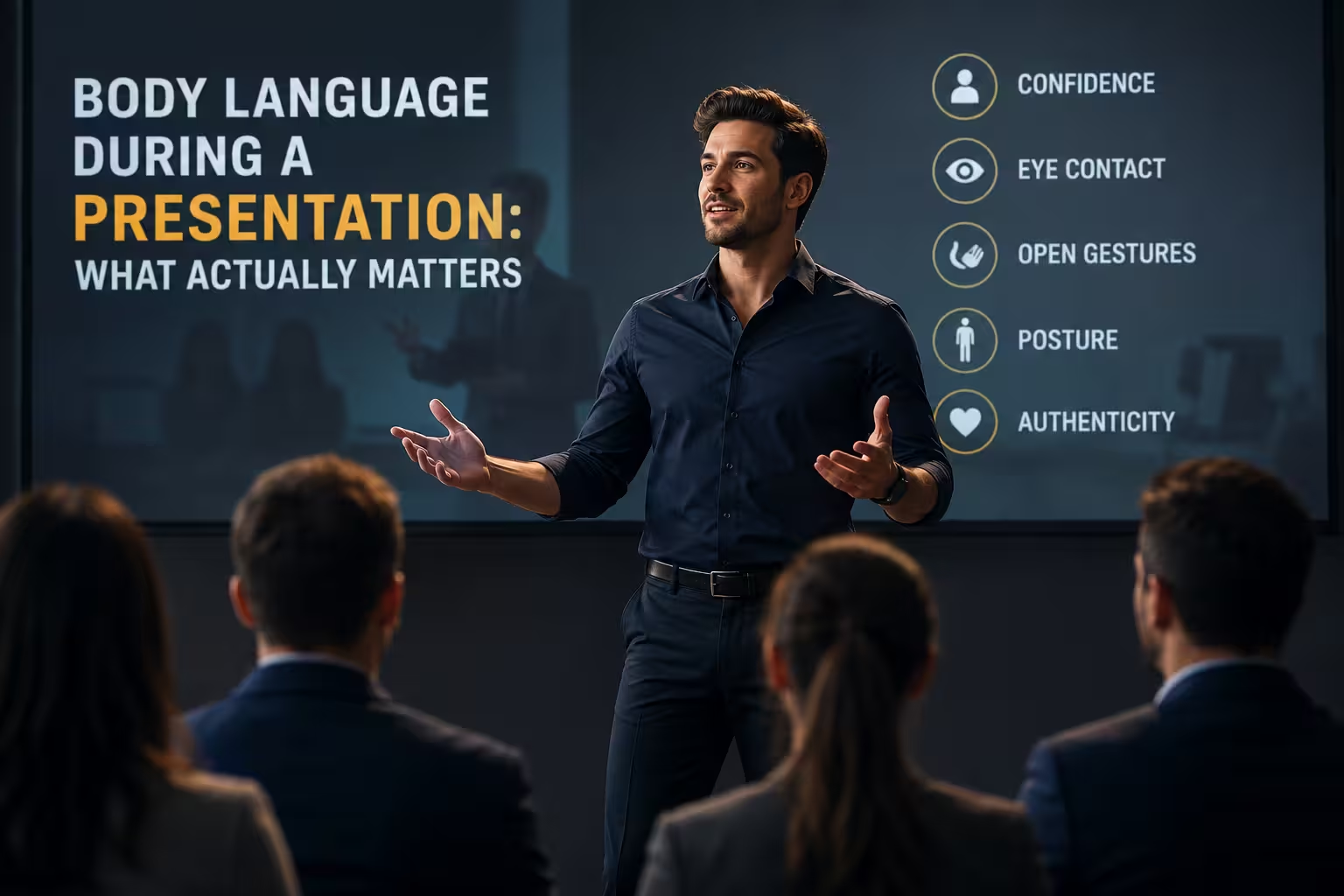
A colleague of mine once ran a client pitch that was, by any content measure, flawless — clean structure, sharp numbers, no wasted slides. The client went with a competitor. When she asked why, the feedback was vague: "we just didn't feel it." Nothing in the deck explained that. Her arms had been crossed for most of the meeting.
That gap — between what a presenter says and what an audience decides to believe — is where body language actually lives. It's not a soft skill bolted onto the "real" content. It's a second channel of information running in parallel, and audiences trust it more than they trust your slides, whether they realize it or not.
The 93% Statistic Everyone Misquotes
You've probably seen it in a LinkedIn carousel: "93% of communication is nonverbal." It shows up in nearly every article on this topic, usually with no context and no source. The number is real, but the way it gets used is almost always wrong.
It traces back to Albert Mehrabian's 1967 research at UCLA, and — this is the part that gets dropped — it only applies to one narrow situation: when a speaker's words and tone directly contradict each other, like saying "I'm fine" through gritted teeth. In that specific conflict, Mehrabian found listeners leaned on facial expression and tone far more than the literal words to judge the speaker's feelings. It was never a claim that 93% of all communication, in every context, is nonverbal. Quote it as a general rule in front of anyone who's read the original study and you'll lose credibility fast.
What the number does support, even in its correct narrow form, is worth sitting with: when your body language and your words disagree, the audience believes your body. Not your script.
What Eye Contact Actually Signals (and When It Backfires)
In a study by Vanessa Van Edwards at Science of People, 760 volunteers watched just seven seconds of silent video from TED talks and rated the speakers on charisma, credibility, and intelligence. Their ratings lined up closely with people who'd watched the entire 18-minute talk with full audio. Whatever the audience decided in those first seven seconds, mostly from posture and face, tended to stick.
Eye contact is one of the fastest signals in that window — which is exactly why the standard advice ("make eye contact, it builds trust") is true but incomplete. Holding eye contact too long reads as intense rather than confident. Scanning the room without landing on anyone reads as evasive. And for a meaningful share of presenters, sustained eye contact isn't a confidence issue at all — it's genuinely uncomfortable, sometimes for neurological reasons that have nothing to do with how prepared they are. If that's you, aiming at foreheads or the middle distance between people usually reads as engaged from the audience's seat, even though it costs you nothing internally. The goal was never perfect eye contact. It was the appearance of presence, and there's more than one route to that.
Hands Are Doing More Work Than People Give Them Credit For
Watch a recording of yourself presenting — genuinely one of the more useful exercises for catching this, alongside rehearsing against your actual slides instead of just your script — and you'll usually notice one of two failure modes: hands locked at the sides like a passport photo, or hands doing constant low-level motion that adds nothing.
The useful category is what's sometimes called illustrator gestures — movements that match the content, not just fill silence. Showing scale with your hands when you say "grew by three times." Marking a contrast left-to-right when you're comparing two options. These aren't decoration; they give the audience a second, simultaneous channel for the same idea, which matters more than people assume for retention.
Here's the complication: this changes almost entirely on video calls. Large, sweeping gestures that read as energetic on a stage look chaotic and slightly unhinged in a webcam frame, where your movement range is a foot of space instead of a room. If you present both live and over video, you likely need two different gesture calibrations, not one "good body language" setting you carry everywhere.
Posture Is a Slower Signal Than People Assume
Most advice on posture stops at "stand up straight, shoulders back," as if that's the whole answer. It isn't. Rigid, locked posture — feet planted, spine straight, no movement for ten minutes — doesn't read as confident. It reads as tense, because it usually is; it's the same stance people unconsciously take when they're bracing for something.
What actually reads as settled is small, purposeful movement: a shift in weight when you move to a new point, a step toward the screen when you're about to reveal something, stillness held deliberately during a key line rather than by default. The stillness matters more when it's a choice you make at a specific moment than when it's your resting state for the whole talk. Presenters who never move at all are almost as noticeable, in the wrong way, as presenters who pace constantly.
The Tells You Can't Fully Suppress — and Shouldn't Try To
There's a temptation, once you start noticing all of this, to try to consciously control every signal: force the eye contact, choreograph the gestures, freeze the stance. In my experience this almost always backfires, because an audience is very good at detecting effort. Over-controlled body language doesn't read as confident. It reads as rehearsed in the wrong way — technically correct, faintly robotic.
The more durable fix isn't performing calm. It's removing the things that are making you genuinely nervous in the first place — unclear transitions, a section you haven't rehearsed enough, a slide you don't fully trust. A lot of what gets labeled as "bad body language" is actually downstream of a handful of fixable structural habits that have nothing to do with posture coaching. Fix the shakiness in the content, and the fidgeting often resolves on its own.
None of this means body language is the whole game — a strong deck still matters, and so does knowing where audience attention actually breaks down mid-talk. But it's worth asking, next time you're prepping: are you rehearsing what you'll say, or also what your hands will be doing while you say it? Most presenters only do the first one.
Comments (0)