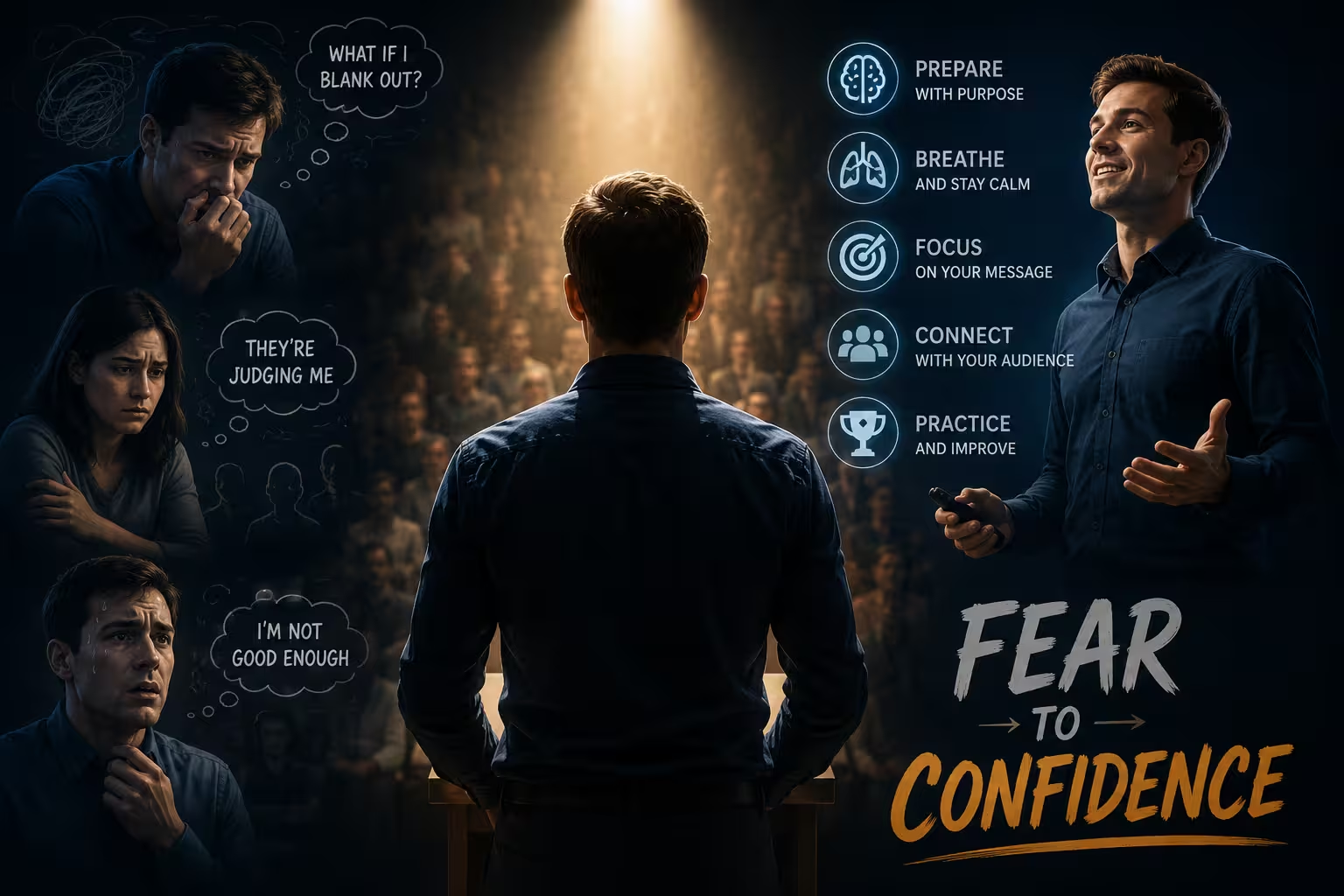
There's a stat that gets repeated in almost every talk about public speaking anxiety: that people fear it more than death itself. It sounds dramatic enough to be true. It also isn't, or at least not in the way it's usually presented — and the real numbers tell a more useful story than the myth does.
Chapman University runs an annual survey asking a representative sample of Americans to rate dozens of fears. Public speaking usually lands somewhere in the thirties, ranked well behind things like corrupt officials, a loved one getting seriously ill, or economic collapse — not at the top, and nowhere near beating a fear of dying. What that means practically is that the fear isn't some universal, unbeatable wall. It's common, it's real, and for a meaningful chunk of people it's manageable with the right kind of preparation — which is different from just "practicing more."
I've sat through enough rehearsals with clients to notice that "fear of public speaking" is really a stand-in phrase for several distinct fears, and they don't respond to the same fix.
Blanking mid-sentence
This is the one people mention first, and it's usually not a memory problem — it's a structure problem. Most speakers who blank aren't trying to recall exact words; they're trying to recall where they are in an argument that has no visible shape. If the only thing anchoring your talk is a script in your head, one skipped line can knock the whole sequence loose.
What actually helps is building the shape into what the audience sees, not just what you rehearsed. A slide that shows "problem → what we tried → what worked" gives you a landmark to glance at and re-enter the flow, even if you've lost the exact sentence you meant to say. I'd rather build a client three or four slides with a visible throughline than one slide that just restates the script — the throughline is what you fall back on when your memory doesn't cooperate.
Being judged as incompetent
Underneath a lot of presentation nerves is a specific, narrower fear: not of the audience itself, but of being caught not knowing something. This is where the standard advice — "picture the audience naked," "just be confident" — tends to fall flat, because it doesn't address the actual thing being feared.
A more direct fix is deciding in advance what you're allowed not to know. Prepare an honest answer for the hardest question you expect ("that's outside what I dug into for this — I can follow up") and rehearse saying it out loud. Once you've said it once in a low-stakes setting, it stops being the emergency your brain is bracing for.
The deck itself turning against you
This one gets left off most lists, probably because it's not about the speaker's psychology at all — but I'd argue it causes as much last-minute panic as anything on this list, because it hits right when you have zero time to recover: fonts substituting on someone else's laptop, a video that plays fine in edit mode and freezes on the projector, an outdated file version opened by mistake.
None of that is really a "confidence" issue, and no breathing exercise fixes it. What fixes it is boring logistics done a day early: export a PDF backup alongside the native file, embed fonts or stick to system fonts, test the actual room's setup rather than your laptop screen, and label file versions so you're not guessing which one is current thirty seconds before you go on. Speakers who've been burned by this once tend to over-engineer it forever after — which is honestly the correct amount of paranoia.
Silence where you expected a reaction
You make a point you think is strong, and the room gives you nothing back — no nod, no laugh, no visible response. It's a small moment, but it rattles people more than almost anything else, because it reads as failure in real time with no way to check if that reading is even accurate.
Here's the complication: silence usually means engagement, not rejection — audiences that are actually bored fidget, check phones, or whisper to each other. Quiet, still attention looks a lot like disapproval from the front of the room and feels completely different from the audience's side of it. Building in one or two moments that ask for an explicit response — a show of hands, a direct question — gives you actual feedback instead of having to guess what silence means, and it breaks up long stretches where you're reading the room with no data at all.
Your body doing something you didn't authorize
Shaking hands, a voice that climbs half an octave, a dry mouth mid-sentence — the fear here isn't really the physical symptom, it's the fear that the audience can see it and is judging you for it. In practice, audiences notice far less of this than speakers assume; a slightly shaky first thirty seconds reads as normal nerves, not incompetence, to almost everyone except the person experiencing it.
Over-rehearsing to eliminate every physical sign of nerves can actually backfire — it tends to flatten delivery into something that sounds recited rather than spoken, which audiences pick up on even if they can't name why. A more sustainable target isn't "eliminate the shake," it's "keep going through it," since the symptoms usually fade a couple of minutes in regardless of what you do.
None of this makes the fear disappear before your next talk — it's not supposed to. What it can do is turn a vague dread into a short list of specific things you've already accounted for, which is usually enough to walk on stage anyway.
Comments (0)