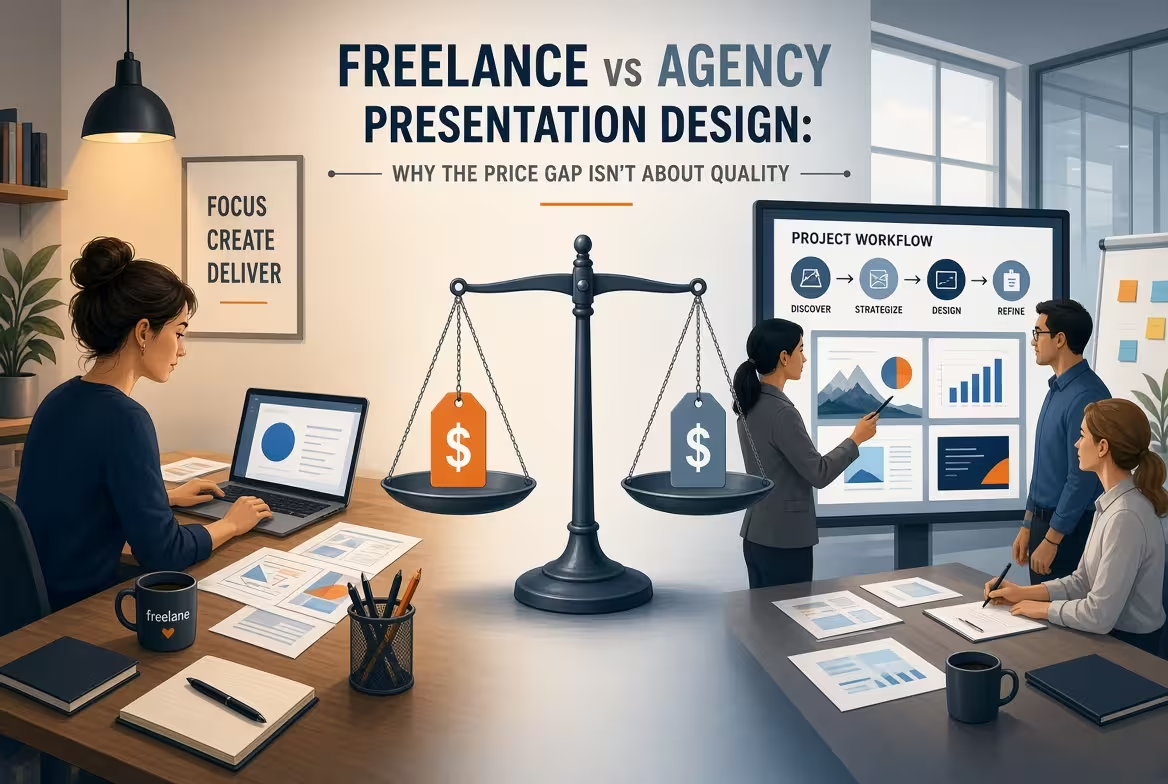
A founder I'll call M. once ran the same pitch deck brief past a freelancer on a talent marketplace and a boutique presentation agency, just to see what would come back. The freelancer's version, built by someone charging $15 an hour, was clean, on-brand, and arguably better paced than the agency's. The agency's invoice was $9,800. Nobody could point to a visible quality gap that justified the difference. So what were they actually paying for?
That's the uncomfortable part of this comparison. Most articles frame freelance vs. agency as a trade-off between cheap-and-risky versus expensive-and-safe, as if price tracked quality on a predictable curve. It doesn't, not in presentation design specifically — the tools are too accessible and the skill ceiling for "make a deck look professional" is lower than people assume. The real divide is somewhere else entirely.
The invoice isn't pricing the slides — it's pricing the confidence to send it
Here's the thing nobody says out loud: a lot of freelancers underprice themselves not because their work is worse, but because they haven't built the muscle to bill for everything a project actually costs them. Revision rounds. The hour spent reformatting after the client changes the brand colors halfway through. The time lost chasing down a logo file in the right resolution. An agency prices all of that in by default, because someone in the building has already had the argument about scope creep and lost money learning the lesson. A freelancer charging $15 an hour has usually just... absorbed it.
This isn't a hypothetical pattern. Industry pricing data compiled by the presentation agency SlideGenius puts freelance rates at roughly $25–$150 per hour or $300–$2,500 per project, against agency quotes of $2,000–$10,000+ for a comparable custom deck. That's not a quality tier — it's two completely different accounting philosophies applied to the same task.
Where the "cheap" rate quietly stops being cheap
I wouldn't recommend judging a freelancer's price by their hourly rate at all — it's the wrong unit. The number that matters is total hours logged against the deck, and that's exactly where freelance pricing tends to unravel.
A GfK survey of over a thousand office workers found that people who build presentations regularly spend around 20 hours a month on PowerPoint work, with roughly 8 of those hours going to formatting alone — aligning colors, fixing broken layouts, redoing things that should have been set up correctly the first time. Now put a freelancer's low hourly rate against that same ratio. If a third to nearly half of billed time is recurring formatting labor rather than design decisions, a "$15/hour" freelancer and a $70/hour one can land at a near-identical total cost once you account for how efficiently each one avoids that formatting tax. The freelancer isn't cheap. They're just not telling you where the hours went.
Agencies, to their credit, usually have already solved this with a template system and a production process — which is a genuine advantage, and also exactly the kind of infrastructure a well-organized freelancer or small studio can build for themselves without the agency markup.
The quality overlap is bigger than either side wants to admit
This is where it gets complicated, and it's worth sitting with the complication instead of resolving it too fast. Agencies are not uniformly better. A junior designer inside a mid-tier agency, working under deadline pressure across six client accounts, can turn out a deck that's competent but forgettable — polished in the way that a stock photo is polished. Meanwhile, a freelancer who's spent five years doing nothing but investor decks can have sharper instincts about narrative pacing and slide density than most agency account teams, simply because they've made more decks under more direct feedback.
So the honest version of the comparison isn't "agency = safe, freelancer = risky." It's that agencies buy you a floor — a guaranteed baseline below which the output won't fall, because there's a review process and someone's job depends on catching problems before you see them. Freelancers have no floor and no ceiling. You might get the best deck of your year. You might get something that needs three rounds of rescue work. The $10,000 isn't buying better slides. It's buying a narrower range of outcomes.
What actually changes when the stakes go up
Where this starts to matter in practice: the moment a deck stops being an internal update and becomes something with money or reputation attached to the outcome — a Series A pitch, a board presentation, a proposal in front of a client who's also evaluating two competitors — the cost of a bad outcome stops being "redo it" and starts being "lost deal." That's the point where paying for a narrower outcome range is a legitimate hedge, not a status purchase.
But that threshold is specific, not general. An internal quarterly review, a training deck, a one-off conference talk — these are exactly the cases where the agency premium buys you almost nothing, because the downside of an imperfect deck is mild and recoverable. One thing people overlook here: the decision isn't freelancer-vs-agency in the abstract, it's "how expensive is it if this particular deck underperforms," asked project by project rather than settled once as a policy.
A cheaper way to close the gap yourself
There's a third option that the freelance-vs-agency framing usually skips: building from a professionally structured template instead of a blank slide, which removes a large chunk of the formatting hours that both freelancers and agencies are quietly billing you for. It won't replace strategic thinking about narrative or audience, but it does eliminate the layout guesswork that eats into that GfK-reported formatting time. Browsing a template library built for the platform you're presenting in is a reasonable first move before you commit to either a $15/hour freelancer or a five-figure retainer — it tells you how much of your "design problem" was actually a structure problem.
And if the project genuinely needs custom work but not agency-scale overhead, it's worth asking whether a smaller, direct custom-design service gets you closer to agency reliability without the agency markup — a scoped custom design request sits in that middle zone more often than people expect.
Next time a quote comes in — whether it's $15 an hour or $10,000 flat — the question worth asking isn't "is this fair for a presentation." It's "what specifically is this number protecting me from." Sometimes the answer is nothing. Sometimes it's exactly the thing you can't afford to get wrong.
Comments (0)