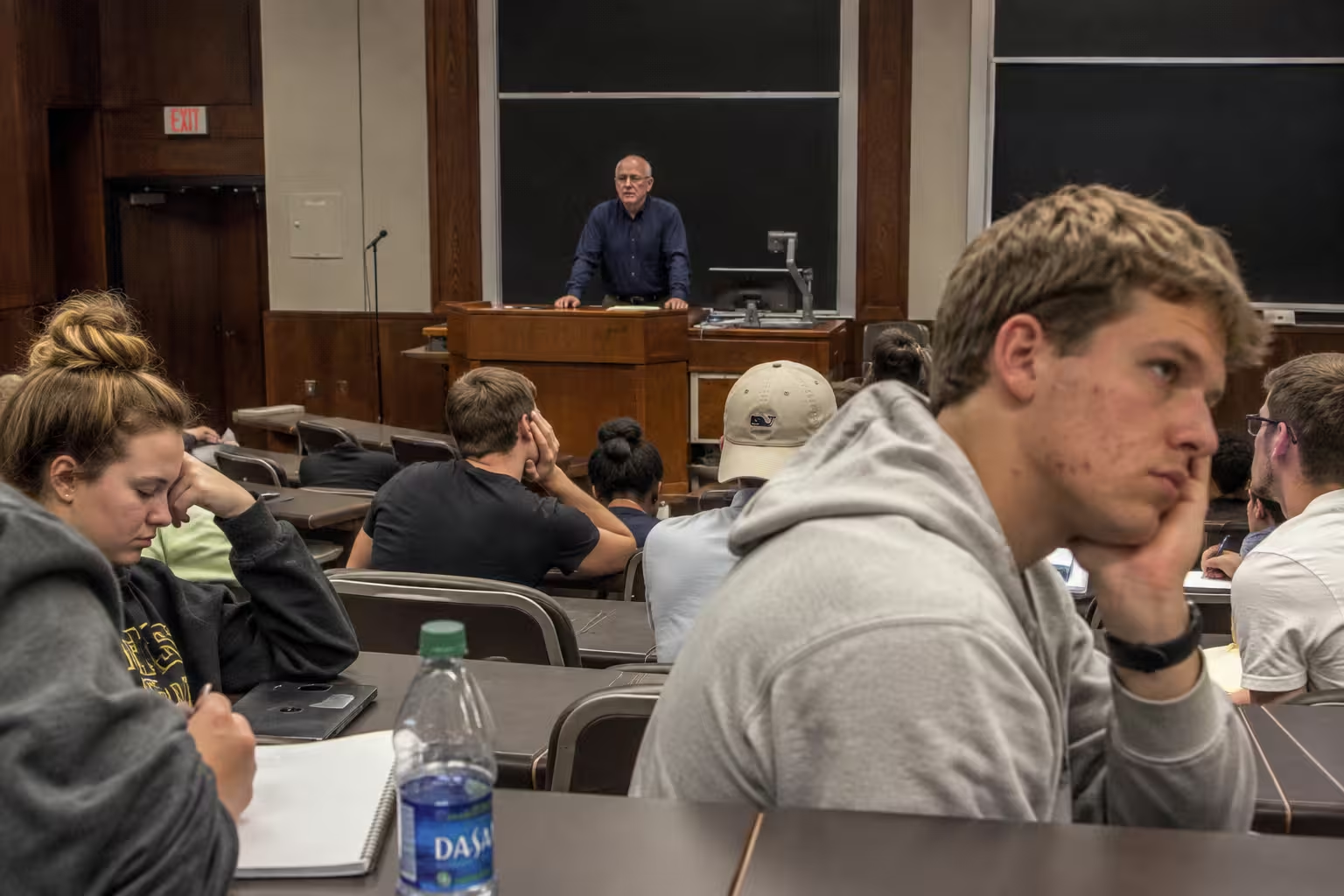
Picture a professor pacing in front of an empty whiteboard, talking for fifty straight minutes about cellular respiration with nothing to look at but the fluorescent lights. No slide. No diagram. Not even a stick figure. And yet somehow this is still considered "traditional" teaching, as if tradition were a defense rather than a symptom. Why does this format, decade after decade, keep putting entire rooms of adults to sleep?
The lecture was never designed for how attention actually works
Here's the part that surprises people: it's not that lectures are long. It's that the human brain was never built to sustain focus on a single unbroken audio stream for that long, full stop. A study of medical students on lecture boredom found that almost 60% of students reported being bored during at least half their lectures, and 30% said they were bored during essentially all of them (Ubah, 2018, Advances in Social Sciences Research Journal). That's not a motivation problem. That's a format problem, and it shows up whether the students are training to save lives or just trying to pass a Tuesday afternoon.
In my experience sitting through more badly-run lectures than I'd like to admit, the moment nothing changes on stage — no new object, no new shape, no shift in visual rhythm — the brain quietly reallocates itself to literally anything else. Grocery lists. Old arguments. The ceiling tiles.
Voice alone can't carry an hour, no matter how good it is
People love to say a "captivating speaker" doesn't need slides. Sure — for fifteen minutes, maybe twenty, if the material is genuinely gripping and the delivery is theatrical. But most lecture material isn't a TED talk about near-death experiences; it's enzyme kinetics, tax law, or the Congress of Vienna. And a chemistry-education study using in-class clickers found that attention doesn't decline gradually and predictably over a lecture — it drops off in short, repeating cycles that get shorter and more frequent as the lecture goes on, and that introducing something other than straight lecture (a demonstration, a clicker question) measurably reduced how much attention students reported losing, an effect that carried over into the lecture segments right after it (Bunce et al., Journal of Chemical Education).
Which is the inconvenient bit for anyone who insists charisma is enough: the intervention that worked wasn't "be more charismatic." It was "give the room something to do that isn't just listening."
Where it gets complicated: bad slides aren't actually an upgrade
Now, before this turns into "just add PowerPoint," here's the twist that most articles conveniently skip: a wall of bullet points read aloud verbatim is arguably worse than no slide at all, because now the room is trying to read and listen at the same time, and losing on both fronts. I've watched teachers "add visuals" by pasting in a paragraph of text and calling it a day — and attention in the room didn't improve, it just changed shape. Instead of staring at the ceiling, students stared at a slide they'd already finished reading forty seconds ago.
The fix was never "more slides." It's slides that do something a spoken sentence can't — show a relationship, a sequence, a comparison — instead of slides that just repeat what's being said out loud.
What a lecture actually needs isn't decoration, it's structure you can see
One thing people overlook: the value of a visual isn't decorative, it's structural. A diagram doesn't just "look nice next to the talking" — it gives the room a second channel to hold onto when the audio one inevitably drifts. If a professor is explaining how three variables interact, a simple relationship diagram does in one glance what four minutes of spoken explanation struggles to land, because the room can re-check it without asking the professor to repeat themselves. That's the actual argument for a relationship chart in an education context — not that it's pretty, but that it survives the moments when someone's attention comes back online three sentences late and needs to catch up visually instead of interrupting.
The same logic applies to breaking dense material into stages instead of one continuous monologue. A quarterly-report style matrix or a staged process chart forces content into digestible chunks almost by accident — the format itself won't let you cram everything into one wall of text, which is precisely the constraint most lecturers need and almost never impose on themselves. There's a reason education-focused education keynote templates tend to break content into discrete visual stages rather than one long slab — it's not a stylistic choice, it's a concession to how attention actually behaves in a room.
The "10-15 minute rule" gets quoted constantly, and it's shakier than people think
You've probably heard that attention collapses exactly 10 to 15 minutes into any lecture, as if there's a biological timer. A review published in Advances in Physiology Education pointed out that this widely repeated figure traces back to surprisingly thin primary research, and that real attention lapses show up earlier and far less predictably than the tidy 10-15 minute story suggests — sometimes within the first few minutes, sometimes in short bursts that repeat throughout. I wouldn't recommend building an entire teaching philosophy around a number that shaky. What the underlying research does agree on is messier and more useful: attention doesn't fail once, it fails repeatedly, in shorter and shorter cycles, unless something interrupts the pattern.
Which means the fix isn't "insert a break at minute twelve." It's "assume the room's attention is already leaking well before you'd expect, and build in visual re-entry points instead of one dramatic pause."
So why does the empty-whiteboard lecture survive?
Probably because it's the format that requires the least preparation from the person at the front of the room, and the most tolerance from everyone else. It's not that teachers don't care — most of the ones I've spoken with clearly do — it's that building visual structure into a lecture takes time most of them were never given, on top of everything else they're already doing without enough support. Next time you're sitting through fifty minutes of someone talking at a blank wall, it's worth asking whether the room is bored because the topic is dull, or because nobody gave your attention anywhere to land.
Comments (0)