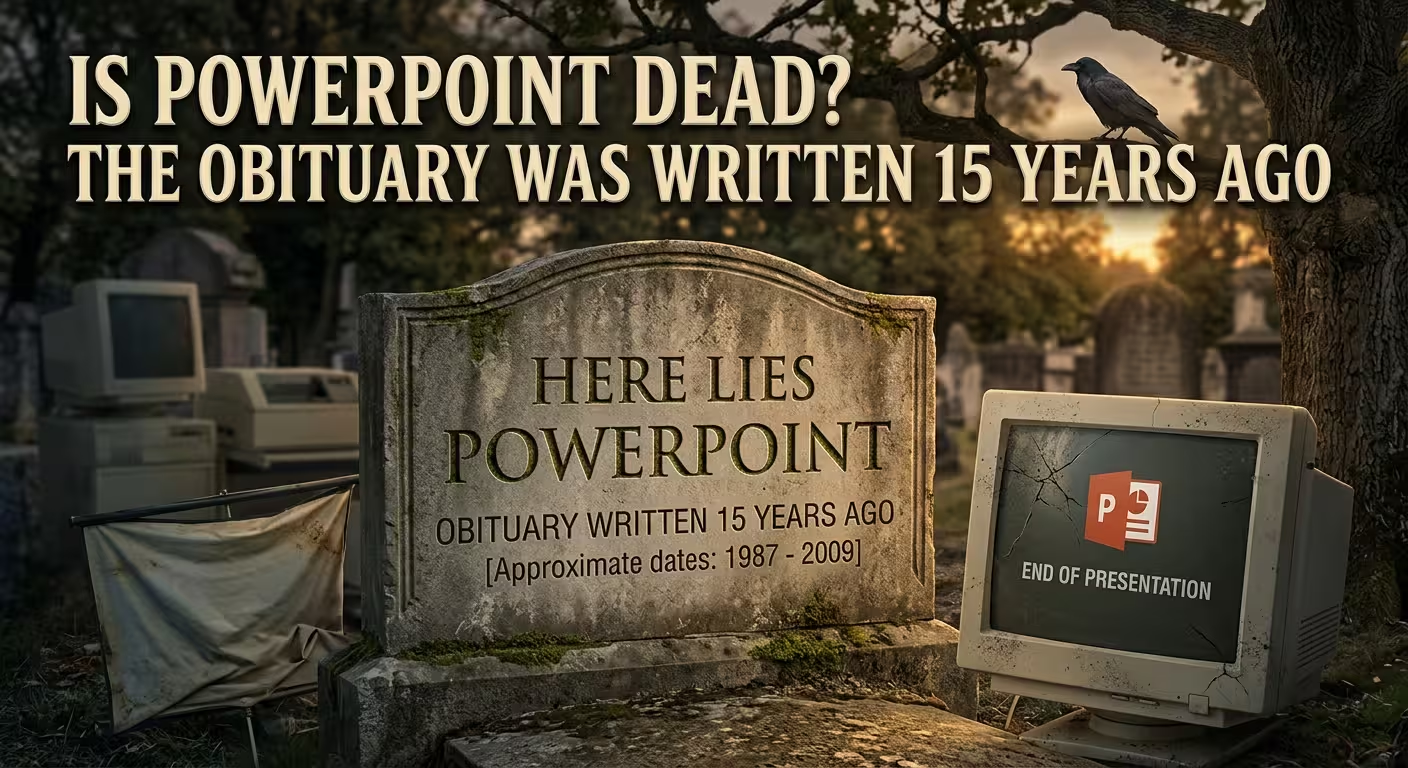
Open a laptop in almost any office in 2026 and you'll still find the same file sitting in someone's "final_v3" folder: a title slide, six bullet points a slide, a stock photo of people pointing at a whiteboard. Meanwhile, a steady stream of posts keeps declaring that AI has finally killed PowerPoint — that Gamma or the latest Copilot update is the thing that ends it. Both of those things are true at once, and neither is really the interesting part.
The interesting part is that "PowerPoint makes people think worse" wasn't a 2024 discovery. It was written down, with real consequences attached, more than two decades ago — and the people who wrote it down weren't slide-deck bloggers. They were a NASA accident investigation board, the founder of Amazon, and three-star generals speaking on the record to the New York Times. This isn't a new debate wearing an AI costume. It's an old, settled diagnosis that the industry has spent twenty years re-discovering every few years and then quietly ignoring again.
The Obituary Was Written in 2003, Not 2024
In 2003, statistician and information-design theorist Edward Tufte published a short essay called "The Cognitive Style of PowerPoint." It wasn't a design critique about bad templates. It argued that the software's structure itself — forced outlines, rigid hierarchy, roughly forty words per slide — actively degrades how people reason through complex information, regardless of who's presenting or how well they design.
That argument stopped being theoretical a few months later. The Columbia Accident Investigation Board, examining why NASA engineers underestimated the risk of the foam strike that destroyed the shuttle on re-entry, singled out a specific Boeing briefing slide. The board's own report — not Tufte's essay, the government's official finding — concluded that as safety-critical information moved up the chain of command through PowerPoint slides, the qualifying details and uncertainty that should have triggered alarm got compressed out, bullet by bullet, until a life-threatening risk read as routine.
That's the actual starting point of this conversation: a federal accident report naming a specific software's formatting conventions as a contributing factor in seven deaths. Every "PowerPoint is broken" argument since — including the AI-tool marketing copy from the last two years — is downstream of a claim that was already tested against the worst possible real-world stakes and found to hold up.
Amazon Ran the Alternative as a Live Experiment — and Almost No One Copied It
If Tufte's argument sounds abstract, Jeff Bezos turned it into policy. In June 2004, he banned PowerPoint from Amazon's senior meetings and replaced it with a six-page narrative memo, written in full sentences, that the room reads in silence for the first part of every meeting before anyone speaks. Bezos's own stated reasoning wasn't about aesthetics: a slide lets an idea sit next to another idea without ever explaining how they connect, while a memo written in complete sentences has nowhere to hide a gap in the logic.
What makes this a stronger data point than Tufte's essay is duration. This wasn't a pilot program — it's been Amazon's standard operating procedure for over two decades, survived a CEO transition, and Bezos was still defending it publicly as recently as a few years ago. An organization with essentially unlimited resources to build or buy any presentation tool it wanted instead chose to remove the tool category entirely, and never reversed the decision. That's about as close to a controlled, multi-decade experiment on "does the software matter" as corporate America has ever run — and the result was that the format, not any particular company's version of the format, was the variable that mattered.
Here's the part almost every retelling of the Amazon story skips: virtually no other large company copied it. Not because the memo approach failed elsewhere it was tried, but because most organizations never seriously tried it. A bullet-point deck does something a six-page memo can't — it lets a presenter control pacing, avoid being pinned to a specific claim in writing, and get through a room in twenty minutes instead of an hour. Those are organizational incentives, not technology limitations, and no software swap fixes an incentive.
The Generals Said It Out Loud in 2010, on the Record
This is the part the "15 years in the coffin" framing is really pointing at. In April 2010, the New York Times ran a story — reported by Elisabeth Bumiller — built around a single briefing slide shown to General Stanley McChrystal in Kabul, meant to illustrate U.S. strategy in Afghanistan, that looked instead like a tangled diagram with no clear entry point. McChrystal's dry response, that understanding the slide would mean winning the war, got a laugh in the room and then got repeated across every major outlet for weeks.
The more consequential quotes in that same article came from officers who'd already tested the alternative under fire. Brigadier General H.R. McMaster had banned PowerPoint presentations years earlier while leading the campaign to secure Tal Afar in Iraq, and described the format as actively dangerous — not merely tedious — because it creates an illusion of understanding and control that isn't earned. General James Mattis, at a military conference that same month, argued flatly that the tool degrades the thinking of the people using it, and made the point by giving his own talk without slides.
Sit with the timeline: that's a national newspaper, quoting active three- and four-star officers, saying — by name, on the record — that PowerPoint was actively harmful to serious decision-making, sixteen years before this article. If a diagnosis that specific, that public, and that authoritative didn't kill the tool, the reasonable conclusion isn't "nobody's said it yet." It's that whatever PowerPoint is actually solving for has nothing to do with whether the criticism is valid.
AI Didn't Bury the Habit. It Just Automated It Faster
Which is the useful lens for the current AI-slide moment, because the pattern is repeating in miniature. Tome launched in 2022 as, explicitly, the tool that would replace PowerPoint — grew to roughly 20 million users, raised tens of millions in funding — and by April 2025 had sunset its own presentation product entirely, redirecting the team toward an AI-native sales CRM instead. Twenty million signed-up users wasn't enough to keep the "kill PowerPoint" product alive, because reaching the top of a hype cycle and solving the underlying problem turned out to be two different achievements.
Gamma is the more interesting counterexample, because it's the one that's actually winning by every startup metric — tens of millions of users, a multibillion-dollar valuation as of a late-2025 funding round — and it's still drawing the same two specific complaints from independent reviewers over and over: every deck it generates is visibly identifiable as "a Gamma deck," and exporting to an actual editable .pptx file tends to scramble layouts and fonts on the way out. A closer look at why Gamma, Tome, and their AI-slide peers keep drawing this exact criticism makes a point worth sitting with: none of these tools, including the successful one, actually solve for a deck that looks deliberately designed instead of assembled from a template a thousand other users also generated. That's the same complaint Tufte made about default hierarchy in 2003 — a format doing the thinking instead of the person using it — just running at generation speed instead of typing speed.
What's Actually Dead, and What Never Was
So is PowerPoint dead? The file format clearly isn't — it's still the thing most organizations standardize on for anything that needs to survive being forwarded, opened without the original author present, or edited by five different people over six months. What's been dying in slow motion since 2003 is something narrower: the assumption that opening PowerPoint and filling in a bullet template is, by itself, a substitute for deciding what the reader actually needs to walk away believing.
Apple's own stage keynotes are the clean illustration of the actual variable. They're built in Keynote rather than PowerPoint, but what really separates an Apple keynote from a bad PowerPoint deck has almost nothing to do with which app is open — it's a presentation that only has to work in one room, for one narrator, backed by an unreasonable amount of rehearsal, which is a job most corporate decks were never built to do. Swap the software and keep the habit of writing a six-bullet transcript of what you're about to say out loud, and you've built a bad Keynote deck instead of a bad PowerPoint one.
The audience-attention data makes the same point from a different angle. Recent tracking of how investors actually move through pitch decks shows total review time shrinking every year and the opening page absorbing more than double the attention of anything after it — a pattern that has nothing to do with which tool generated the deck, and everything to do with whether the person building it decided, before opening any software, what the reader has to believe in the first fifteen seconds.
None of that means the memo-versus-slide argument is settled, either — a deck built for live narration and a document built to stand alone without you in the room are doing genuinely different jobs, and Bezos's memo format solves for the second one specifically, not for every presentation context. What the 2003, 2004, and 2010 record actually settles is narrower and more useful: this diagnosis has already survived a spacecraft disaster, a two-decade corporate experiment, and a war zone. The tool being used to write the bullets was never really on trial. The question that's still open, the same one it was in 2003, is whether the person filling in the template decided what to say before they opened it — and no AI update has touched that part yet.
Comments (0)