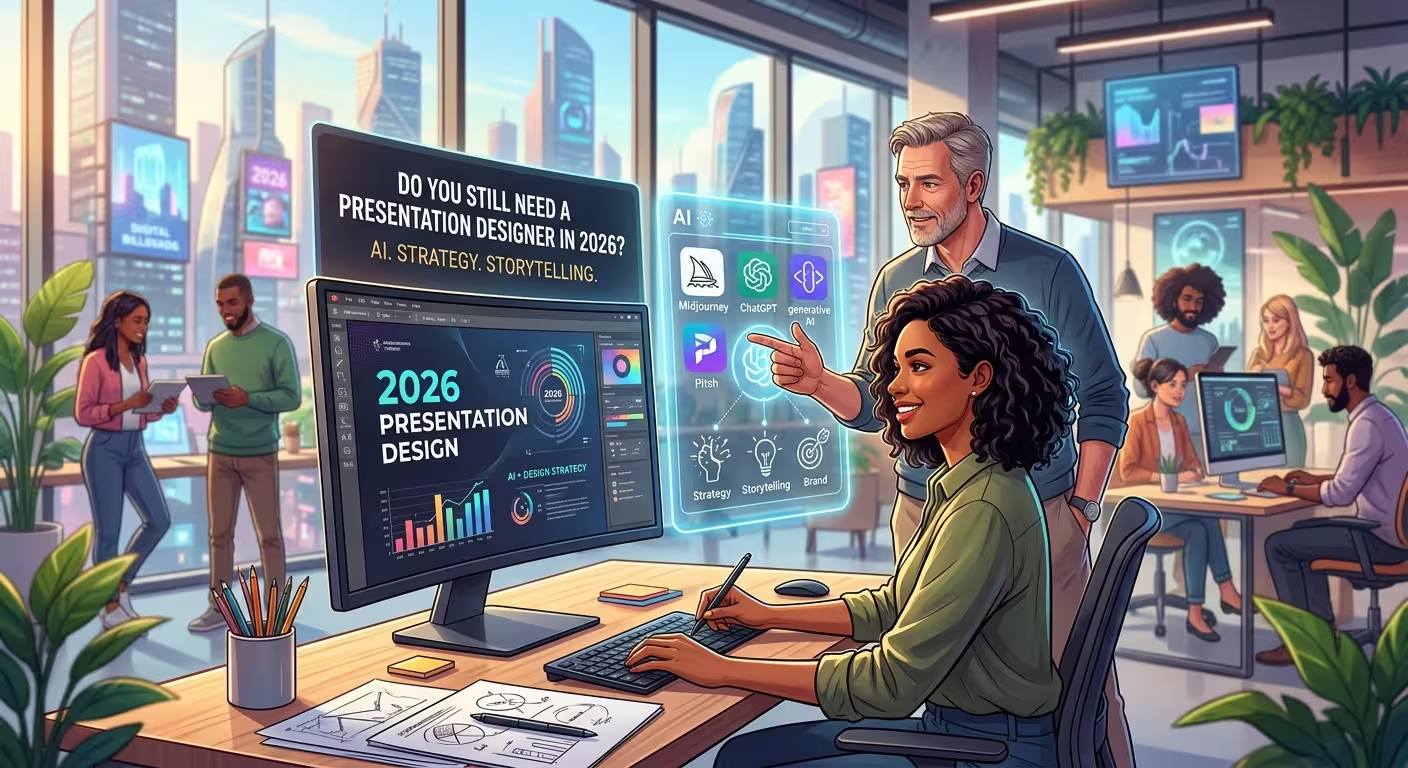
The Question Is Backwards
Every few months someone in a marketing or ops Slack channel asks whether presentation designers are becoming obsolete, and the thread always splits into the same two camps within about four replies: "AI already does this better" versus "AI slides all look the same and clients notice." Both sides are arguing from a real experience. Neither one is actually answering the question, because the question — "do you need a presentation designer" — assumes designing a presentation is one job. It isn't. It's at least three: deciding what the deck should argue, deciding what to leave out, and deciding how it should look. AI has gotten very good at exactly one of those.
What the AI Deck Generators Actually Absorbed
A Study.com survey of 1,000 U.S. employees conducted in early 2026 found that creating presentations ranked as one of the three most common uses of AI tools at work, trailing only general research and writing emails. That's not a niche behavior anymore — it's become a default first step for a large share of people who used to open a blank slide and start dragging text boxes around.
What it's replaced is the mechanical layer: picking a layout, aligning objects, generating a color palette that doesn't clash, turning a paragraph into a bulleted slide. That layer used to eat hours. Now it takes a prompt. If your deck is an internal update, a training recap, or a one-off explainer nobody outside your team will see, there's a real argument that paying a designer for that layer is money spent on a problem that no longer exists.
Except When the Deck Has to Survive Contact With an Audience
Here's where it gets less tidy. Ask an AI tool to build a 40-slide investor deck and it will hand you 40 slides — evenly paced, evenly weighted, evenly confident. That evenness is the problem. A pitch that gives the same visual emphasis to "we raised a seed round" and "our churn rate" isn't wrong exactly, it's just missing the judgment call about which of those two facts the room needs to sit with longer. Sequencing an argument — what goes first, what gets cut entirely, where the one slide with more white space than the rest earns its pause — is still something a person has to decide on purpose. AI will format whatever structure you give it beautifully. It won't tell you your structure is wrong.
The Brand Problem Nobody Budgets For
There's a second gap that shows up less in individual decks and more at the company level, and it's less about creativity than compliance. In empower's Ultimate Global PowerPoint Study, 96% of respondents said following corporate design guidelines mattered, with 62% calling it very important — but the same study found a persistent mismatch between how much people say they value consistency and how consistent their actual output is, because most employees are building slides ad hoc rather than working from a governed system. AI tools don't fix this on their own; they'll happily generate a deck in whatever aesthetic the prompt implies, brand guide or not. What closes that gap is either a person maintaining the system, or a template library built once, correctly, and reused — which is functionally the same fix wearing a cheaper outfit.
This is the case for a hybrid setup rather than a binary one: a custom-built template system that locks your fonts, colors, and slide masters once, so that whatever gets generated afterward — by AI, by an intern, by you at 11pm — inherits the constraints instead of needing a human to police them slide by slide.
A Rough Filter, Not a Rule
If the deck is low-stakes, internal, or one of many you'll produce this quarter, a solid template pool does more for you than a designer would. Pre-built diagram layouts and chart templates cover the mechanical layer AI already handles well, and they're editable enough that a non-designer can hit "good enough" in under an hour.
If the deck decides something — funding, a client relationship, a board vote — the cost of getting the sequencing wrong is larger than the cost of a designer's day rate, and that's the actual comparison worth making, not "AI vs. human" in the abstract.
Where This Leaves You
I wouldn't hire a designer for a weekly status update, and I wouldn't hand a Series B pitch entirely to a generator and call it done. Most teams already sense this — they just haven't drawn the line explicitly, so they either overspend on decks that didn't need a human touch or underinvest in the one deck that did. Worth asking before your next presentation isn't "do I need a designer," but "what is this deck deciding, and can I afford to get that part wrong?"
Comments (0)