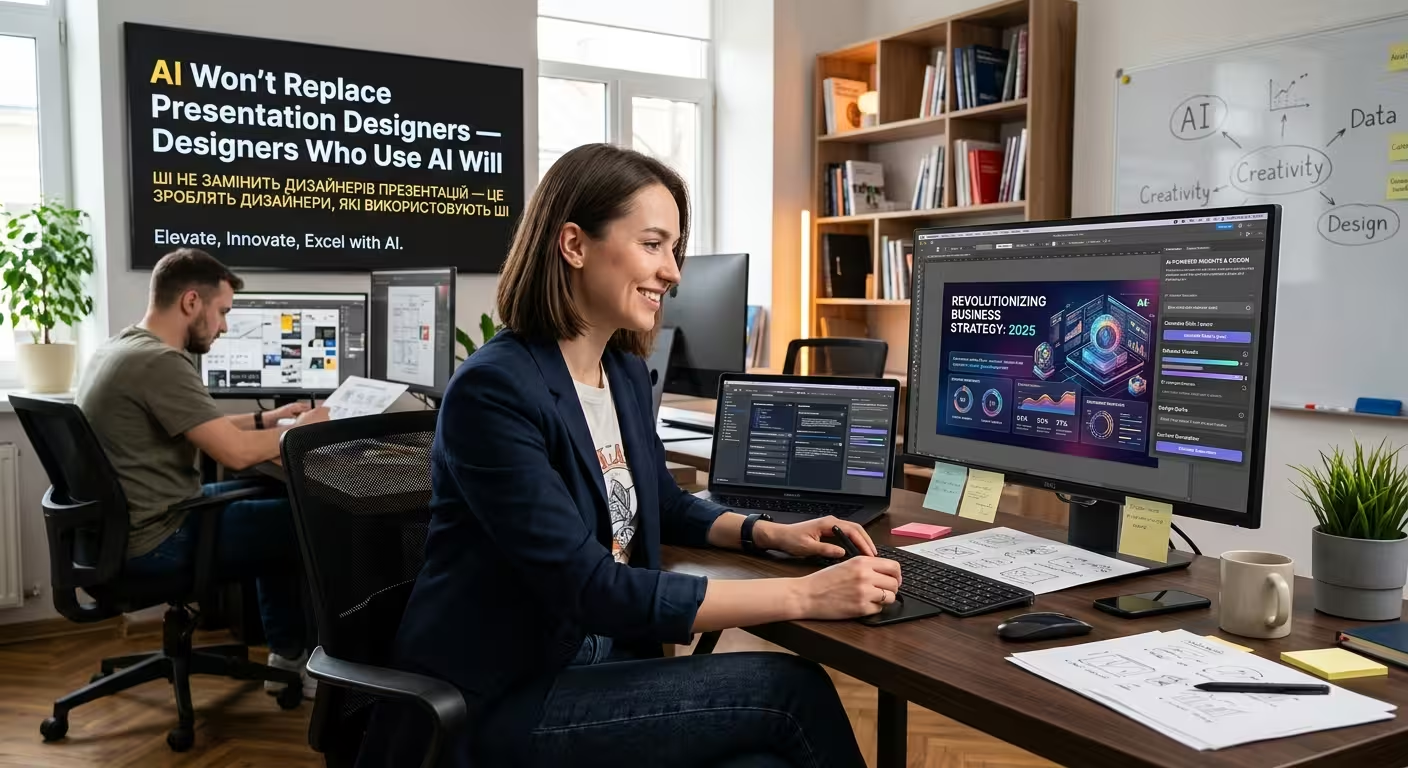
Last year I watched a junior designer spend four hours rebuilding a 30-slide investor deck by hand, redrawing every icon from scratch because the client "wanted something original." In the next room — a hypothetical scenario, but one I've seen versions of more than once — a designer with roughly the same experience level ran the same brief through an AI layout tool, got a rough first pass in twenty minutes, and spent the rest of the afternoon doing the part that actually mattered: fixing the visual hierarchy, tightening the narrative arc, and making sure slide 14 didn't contradict slide 3. Same deadline. Wildly different day.
That gap isn't about talent. It's about workflow. And it's the reason the "AI will replace designers" conversation is asking the wrong question.
The fear is real, the mechanism is wrong
Nobody's job disappears because a tool exists. Jobs disappear because someone else uses that tool to do the same work in less time, at a lower price, or with more iterations shown to the client before a decision gets made. That's not a new dynamic — it's what happened when desktop publishing replaced manual paste-up, and when template libraries replaced from-scratch slide builds for routine business decks. AI layout generation is the same shift again, just faster.
What's different this time is the pace. The AI in Design 2026 report from Designer Fund and Foundation Capital, based on a survey of more than 900 designers across 60-plus countries, found that weekly AI use among designers jumped from 54% in 2025 to 91% in 2026 — a change that would normally take years, compressed into twelve months. When adoption moves that fast, the gap between "uses AI" and "doesn't" stops being a preference and starts being a pricing problem for whoever's on the wrong side of it.
What AI actually takes off your plate
Here's where it gets specific, because "AI helps with presentations" is vague enough to be useless. In practice, on a typical client deck, AI tools are good at:
- Generating a rough slide sequence from a content outline or transcript
- Producing first-pass icon sets and simple illustrations that get replaced or refined later
- Rewriting dense client copy into slide-length bullets
- Suggesting chart types once you've told it what the data is meant to prove
None of that is design work in the sense a client is paying for. It's the scaffolding around design work — the part that used to eat the first two or three hours of a project before you got to the decisions that actually shape how the deck reads.
What it doesn't take — and where people get this wrong
I'd expect the next line here to be some version of "but AI can't replace human creativity," and technically that's true, except it's not the reason AI-generated decks still look wrong most of the time. The real reason is narrower and more useful: AI has no memory of what slide 3 promised by the time it builds slide 14. It optimizes each slide as its own object, not as a beat in an argument.
That's the actual job now. A presentation is a sequence of claims building toward a decision, and holding that sequence together — knowing which slide to cut because it repeats an earlier point, which chart to simplify because the audience won't sit with three variables — is still entirely a human call. AI can generate the pieces. It can't tell you which pieces the argument needs.
The workflow that actually changes, not just the tools
One thing people overlook: swapping in an AI tool without changing the surrounding workflow usually makes things slower, not faster, because you end up regenerating the same slide six times hoping the output improves on its own. It rarely does. The designers getting real speed gains are the ones who changed the order of operations — outline and structure first, fully locked, before any AI generation touches a single slide. Generate inside a structure and the output is usable. Generate without one and you're just producing more raw material to sort through later.
The same discipline applies to where you start visually. Beginning from a structured diagram framework instead of a blank canvas or an unfiltered AI output gives you a layout logic that's already been tested against real content — which is usually faster to adapt than it is to untangle an AI-generated slide that looks fine until you try to edit it.
Where this actually threatens someone's job
The risk isn't "AI replaces the designer." It's narrower and more uncomfortable: a client who used to pay for 40 hours of deck production now only needs to pay for 15, because the scaffolding work — the outline pass, the first-draft visuals, the rough chart selection — got absorbed into a tool. If your value proposition was mostly the scaffolding, that's the part that's shrinking. If your value was the judgment calls — what to cut, how to sequence, how to translate messy client thinking into something a board can follow in six minutes — that part hasn't shrunk. If anything it's more visible now, because it's the only part left that clients can't get from a prompt.
This is also where a lot of freelance and agency work is quietly shifting toward hybrid delivery — AI-assisted first passes handed off for custom design refinement rather than full manual builds, which changes the pricing conversation more than it changes the design conversation.
What to actually do with this
If you build presentations for a living, the practical move isn't "learn Midjourney" or "try Gamma" — tool literacy is table stakes now, not a differentiator. The move is auditing your own workflow honestly: how many of your billable hours currently go to scaffolding versus judgment? If it's mostly scaffolding, that's the part worth compressing, not defending. Chart selection is a good place to start, since it's high-volume, repetitive, and easy to speed up without losing quality — a library of tested chart formats does the same job an AI generation loop does, minus the six regenerations.
The junior designer redrawing icons from scratch wasn't wrong to care about originality. She was solving the wrong problem with her time. The deck didn't need original icons. It needed an argument the board could follow in six minutes — and that's still work only a person can do.
Comments (0)