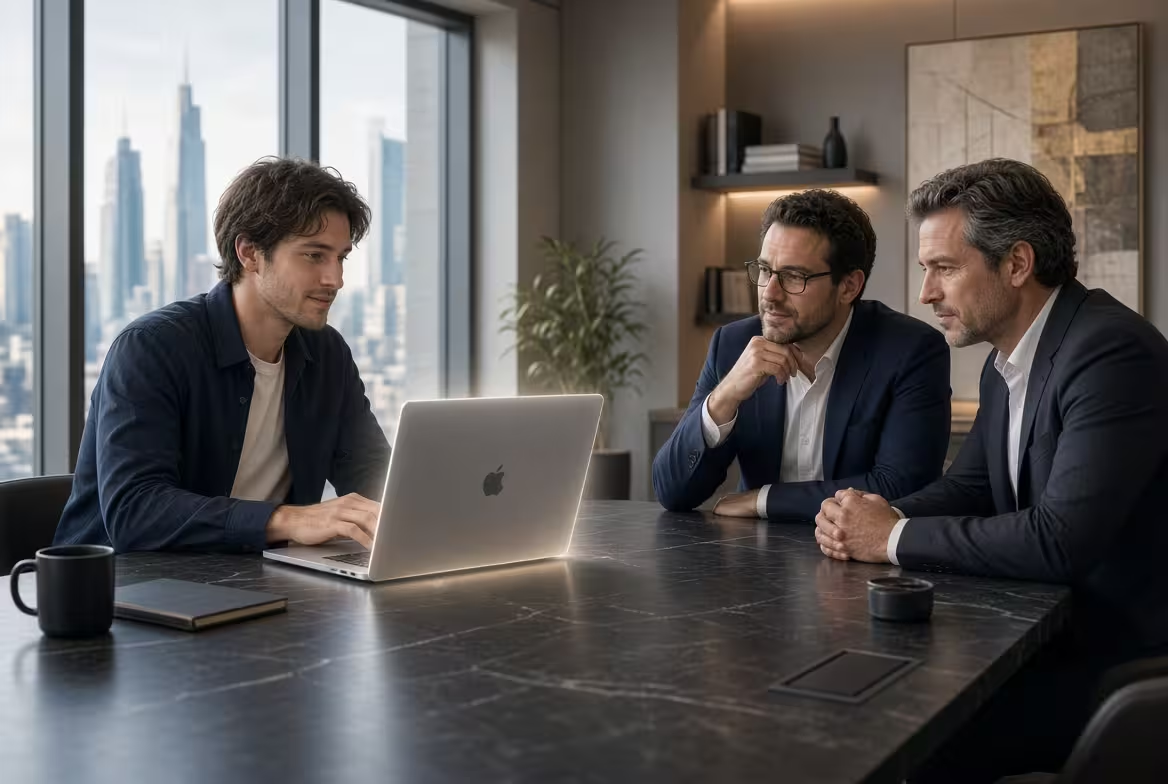
A founder I spoke with last year swapped his ThinkPad for a MacBook Air two weeks before his Series A round opened. Nothing about his stack changed — same repo, same cloud provider, same deck. He just didn't want to be the guy who opens a laptop and a Windows update notification slides in from the corner while a partner is mid-sentence. That's the whole story. No performance complaint, no software he needed. Just a screen he didn't trust to behave itself in front of money.
This happens more often than founders admit, and it's worth asking why a fifteen-minute meeting can move a purchasing decision that specs sheets never could.
The switch isn't about power, it's about what the screen does when nobody's looking
Open a MacBook and the lid resistance, the trackpad click, the boot animation — none of it asks anything of you. Open most Windows laptops fresh out of sleep and there's a real chance of a driver popup, an antivirus banner, or OneDrive quietly renegotiating sync status while you're trying to cast your screen. None of that is a dealbreaker on its own. In a coding session, nobody cares. In a room where a partner is deciding whether you're someone who sweats details, a five-second visual hiccup reads as evidence, not accident.
I've watched founders rehearse the pitch itself for weeks and never once test what their screen actually does when they plug into a conference room display. That's the gap — the meeting starts before the first slide loads.
The market data backs the perception, even if it can't prove the reasoning
Founders aren't imagining a trend. According to Omdia/Informa's US PC market research, cited by Computerworld, Apple's share of the US enterprise laptop and desktop market reached 11% in full-year 2025 — up 2.4 percentage points from the year before — while Mac's overall share across business, education, and consumer segments hit 15.7% in the final quarter of 2025. That's meaningful movement in a market Windows has dominated for three decades, and enterprise buyers don't usually choose hardware for reasons as soft as "how it looks in a meeting."
Except that's exactly the segment where perception carries the most weight. Enterprise IT doesn't buy for investor optics — but a growing share of that 11% is small, VC-backed companies making their own procurement calls, where the person choosing the laptop is also the person who has to walk into a room and be taken seriously. The stat doesn't prove the motive. It does show the shift is real, not anecdotal.
Here's the complication: the laptop is doing less work than the deck is
A MacBook won't rescue a pitch built in default PowerPoint SmartArt with mismatched fonts and a timeline slide that looks like it was assembled at 1 a.m. — which, to be fair, it usually was. Investors read the deck's construction quality faster than they read the hardware. If anything, a sleek machine running a rough deck creates a worse contrast than a mid-range laptop running a tight one, because the mismatch itself becomes the tell: someone spent money on the wrong thing.
Where Keynote genuinely does outperform PowerPoint-on-Windows isn't prestige, it's font substitution and animation rendering — a Keynote file built and presented on the same machine won't fall back to a system font mid-slide the way a cross-platform PowerPoint deck sometimes does when it hits unsupported effects. That's a real, checkable difference, not a status signal. Founders who build in Keynote templates and present from the same machine sidestep that failure mode entirely.
What actually reads as "serious" isn't the brand on the lid
Strip the Apple logo out of the equation and what's left is consistency: the deck opens exactly as designed on the display you're plugging into, the roadmap slide doesn't reset to default spacing when a milestone gets bumped two weeks before the meeting, and nothing on screen looks improvised. A founder presenting a Series A roadmap slide built from a properly structured layout — the kind covered in timeline template collections designed specifically for investor decks rather than repurposed SmartArt — signals command of the material regardless of which OS rendered it.
I wouldn't recommend chasing the MacBook as a shortcut to that impression. It's a proxy, and proxies are easy for an experienced investor to see through once the deck opens. What holds up under a partner's scrutiny is the same thing that holds up in a code review: nothing about the presentation asks the audience to forgive a rough edge.
The detail that outlasts the meeting
The laptop closes at the end of the pitch. What stays on the table — a follow-up leave-behind, a printed one-pager, a card handed across during the small talk after — carries the impression forward longer than the screen did. Founders who treat that handoff with the same intent they gave the slides, down to something as small as a properly designed business card instead of a generic print-shop template, are extending the same signal the MacBook was trying to send in the first place — just through a channel that doesn't power off.
So bring whichever laptop runs your deck without flinching. What the room actually remembers isn't the logo on the lid — it's whether anything on screen made them stop and wonder if you'd rehearsed.
Comments (0)