A marketing director I once worked alongside got two quotes for the same 18-slide investor update: $4,200 from a boutique presentation agency, and $0 extra if she reused the template library her team already had a licence for. She went with the agency anyway. That's the part most "templates vs. agency" articles skip — the decision was never really about price.
Most comparisons on this topic stop at a table: templates are cheap, agencies are expensive, pick one. That's true and also not very useful, because the gap between those two numbers isn't fixed — it moves depending on how often you present, how many rounds of revisions you burn through, and what's actually riding on the deck. Here's how to work out where you land.
What agencies actually charge in 2026
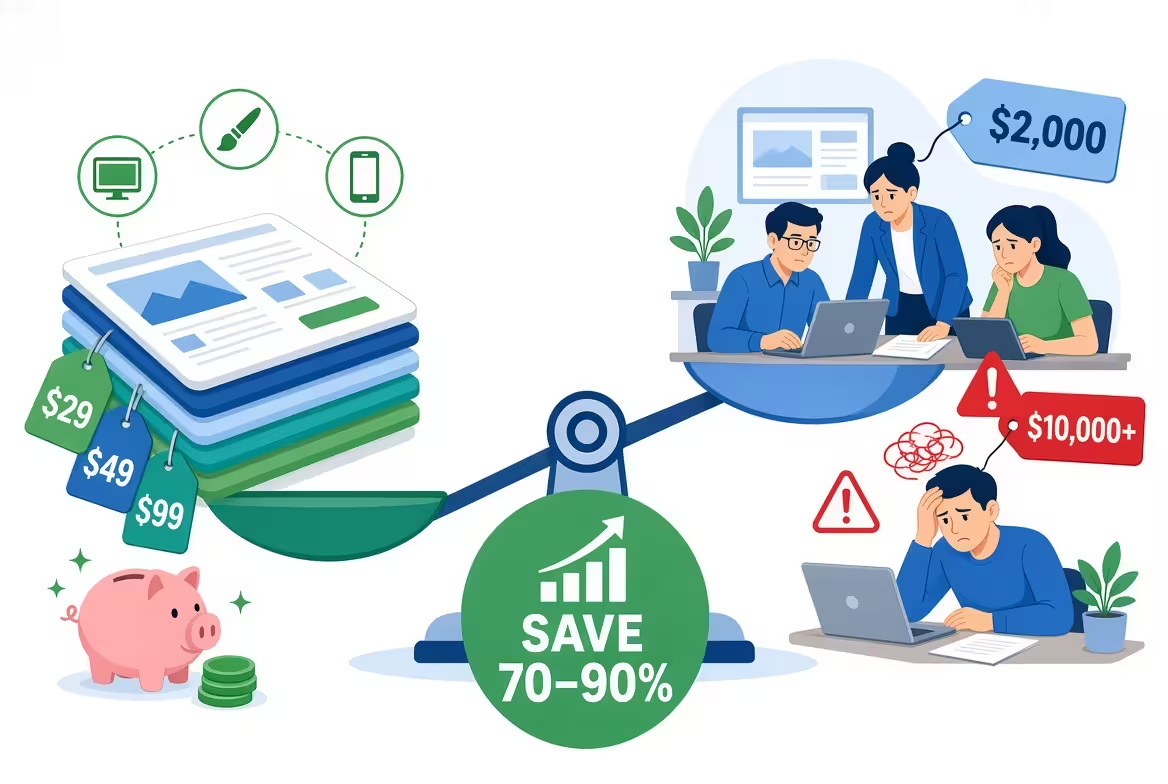
Pin down the agency side of the equation first, because "expensive" isn't a number you can plan around. Pricing research from 24Slides puts the average agency cost at roughly $265 per slide when a project is fully outsourced — which means an 18-slide deck like the one above lands close to $4,770 before rush fees or extra revision rounds. A separate 2026 pricing guide from Whitepage Studio frames it slightly differently: freelancers running $15–$150 an hour, agencies charging $1,500–$10,000+ per project depending on whether it's an internal update or an investor-grade pitch.
Neither number is wrong. They're pricing different things — a freelancer sells you hours, an agency sells you a finished outcome with strategy baked in. That distinction matters more than the raw dollar figure, because it's the thing that determines whether templates can actually substitute for what you're buying.
The template side of the math is almost boring — which is the point
A single well-built PowerPoint template typically runs $10–$40, and a bundle of related decks, diagrams, and chart sets can bring the per-template cost down further when bought together through a template bundle. There's no strategy consultation, no revision rounds billed by the hour, no waiting on a designer's calendar. You get a finished visual system and you fill it in yourself.
I wouldn't frame this as "templates are always the smarter buy," though — that's the generic version of this advice, and it skips the part where your own time isn't free. If it takes you six hours to adapt a template properly, restructure the narrative, and get feedback from three stakeholders, that's six hours pulled from something else. The calculator only works if you price your own time honestly.
A rough formula, and where it breaks
Here's the back-of-napkin version I'd actually use: take the agency quote, subtract the template cost, then subtract your own hourly rate multiplied by the hours you'll spend adapting the template. What's left is your real savings — not the sticker-price gap, the actual one.
For a single one-off internal update, that math almost always favors templates. Spend $20 on a template, two hours adapting it, and you've saved thousands over an agency quote with barely any quality trade-off for an audience that isn't scrutinizing design choices.
But the formula flips hard the moment two things happen at once: the deck is genuinely high-stakes, and you don't have someone in-house who's good at visual storytelling. Pitch deck cost research from spectup notes that agency-built investor decks correlate with meaningfully better meeting and close rates than DIY or low-cost freelance versions — which complicates the "just use a template" advice considerably. A template gives you consistent, professional slides. It doesn't give you someone who knows which three data points actually move an investor, or where your argument has a hole in it. That's a different service entirely, and no amount of template savings closes that gap if the deck's job is to change someone's mind on a six-figure decision.
Where a hybrid actually wins
This is the option most either/or comparisons skip entirely: use a template for the visual system and pay a person — freelancer, in-house designer, or agency on a smaller scope — only for the parts that need judgment. A common pattern I've seen work is a template covering 90% of the slide layouts, with a freelancer brought in just to tighten narrative flow and rebuild the two or three slides that actually carry the argument.
That's not a cop-out answer, it's usually the cheapest path to a genuinely good deck once you count the hours. It also sidesteps the worst version of the DIY trap, which is spending four evenings fighting with slide alignment instead of thinking about what the deck needs to say.
A worked example (hypothetical numbers, illustrative only)
Say a 15-person consulting team produces roughly 20 client decks a year. At an agency rate of $265/slide and an average 12 slides per deck, that's close to $63,600 annually if every deck goes fully outsourced — a number that gets attention fast once someone puts it in a budget line. Standardizing on a custom-branded template system once, then reusing and lightly adapting it for each client deck, could bring that down to a few thousand dollars in template and adaptation costs for the year, with an agency reserved only for the handful of decks that are genuinely make-or-break. This is an illustrative scenario, not a documented case study — the real number depends heavily on deck complexity and internal design skill.
What actually decides it
Don't run this calculation once and lock in an answer forever. The variables — how often you present, how skilled your team is at adapting a layout, how much a single deck is actually worth if it lands — shift throughout the year, and the right call for a quarterly team update is rarely the right call for a fundraising round.
Before your next quote comes in, it's worth asking one honest question: is this deck's job to look competent, or to change someone's mind? The first is a template problem. The second, more often than people admit, still needs a person.
Comments (0)